Alvin Dedeaux of All Water Guides in Austin, Texas, has been a trout, bass, and redfish information for many years, so he’s most likely heard all of it. In his newest video, he solutions the commonest questions he has gotten over time. In case you’re new to the game or know somebody who’s all in favour of changing into a fly fisher, this is a superb start line. Among the best issues about Alvin is that he approaches the game with no ego, angle, or prejudices. The person simply likes to fish and have enjoyable, so he’s the proper individual to introduce the game.
This week’s Tying Tuesday is all about simplicity. These patterns require no particular tying abilities and take only a few minutes to create. We kick issues off with a cool cased-caddis imitation from Cheech at Fly Fish Meals. I’m unsure what he means by “feelers” (legs?), however you tie within the lengthy dubbing fibers identical to a tail. Subsequent up is a basic Appalachian Palmer Fly,” from Matt O’Neal of Savage Flies. All that palmered hackle signifies that the sample will float like a cork within the tumbling mountain streams, and it’ll droop a good dimension nymph, as nicely. Lastly, Tyler from AvidMax presents a simple midge imitation that crushes on tailwaters.
Cased Caddis Jig Hook: Barbless black nickel hook (right here, a Fulling Mill 5140), dimension 14. Bead: Black slotted tungsten bead, 3.2mm. Thread: Fluorescent inexperienced, 8/0 or 70-denier. Tail (feelers?): Black Eco Warrior Dub. Physique: Combined Eco Warrior Dub (black, rust, olive, pepperbox, and hare’s ear), trimmed. Underbody: Tying thread Thread colour: Black Sharpie. Instruments: Dubbing whirl.
Smoky Mountain Palmer(Orange) Hook: 1X-long dry-fly hook, sizes 12-16. Thread: Rusty orange (or brown or black), 8/0 or 70-denier. Tail: Golden pheasant tippets. Hackle: Grizzly and brown, palmered. Physique: Orange yarn. Head: Tying thread. Adhesive: Head cement.
Each native and stocked brook trout habitat was severely broken by Hurricane Helene. Picture: Courtesy the North Carolina Wildlife Sources Fee
Final September, historic rains introduced by Hurricane Helene induced devastation in communities throughout western North Carolina, destroying houses, infrastructure and river programs. Because the area begins to rebuild, the way forward for the fly-fishing trade remains to be an enormous query mark. In response to an article on Blue Ridge Public Radio, trout generated $1.4 billion for North Carolina’s economic system in 2022, and bringing more cash into the area will certainly assist. The issue is, the place will you really be capable to discover fish in 2025? State officers have some recommendation:
This week, the North Carolina Wildlife Sources Fee introduced that some—however not all—hatcheries will reopen to the general public this summer season.
Put up-Helene particles and waterway modifications have made among the public’s favourite fishing rivers inaccessible for the season, which peaks in spring and fall, although some trout fishing is allowed year-round.
Jacob Rash, a coldwater analysis biologist on the North Carolina Wildlife Sources Fee, stated officers are nonetheless assessing hatcheries and streams however trout stocking will probably be extra restricted than common.
“We’re positively anxious to see how issues are doing and getting efforts again to the degrees that anglers have come to count on over time,” Rash stated. “We do understand how vital, whether or not it’s inventory trout or wild trout, actually are to all people.”
Officers will decide—after assessing waterways with injury—whether or not rivers and streams have secure entry to parking and for stocking vehicles and anglers.
When most anglers image a Lahontan cutthroat trout (Oncorhynchus clarkii henshawi), they envision one of many giants caught this time of yr from Pyramid Lake. However the subspecies’ authentic vary is far bigger, involving many small, headwater streams. Lahontan cutthroat trout (LCT) are native to the tributaries of what was as soon as Lake Lahontan—an enormous ice-age lake, of which Pyramid Lake and Lake Tahoe are remnants, in northwestern Nevada and increasing into northeastern California and southern Oregon. These native waters embody the drainages of the Truckee, Humboldt, Carson, Walker, and Quinn Rivers, in addition to a lot of smaller streams. Sadly, the subspecies now inhabits only a fraction of its former vary, and one of many main causes is cattle grazing alongside necessary rearing streams.
The video above, from Western Watersheds Undertaking, illustrates the issue and discusses vital options. The Bureau of Land Administration state workplace in Nevada is presently evaluating livestock administration throughout dozens of grazing allotments that include crucial trout habitat. The Bureau is proposing to “improve operational flexibility” for ranchers. Sadly, a lot of the proposed treatments would depend on extra infrastructure, reminiscent of water developments and fencing on public lands, quite than merely lowering livestock ranges or eradicating grazing from LCT streams.
A small LCT from a wholesome, high-mountain stream.
Western Watershed Act has created an easy-to-use kind that means that you can sens a message to the Bureau of Land Administration, asking them :
Cut back or remove grazing in LCT streams and riparian areas.
Mandate livestock reductions in failing allotments.
Restore riparian habitats by pure restoration, not pricey infrastructure.
Prioritize species restoration over business livestock pursuits.
Take decisive motion to guard these important waterways and guarantee their survival.
The raffle held by the American Museum of Fly Fishing is a cool alternative to fish some hallowed waters.
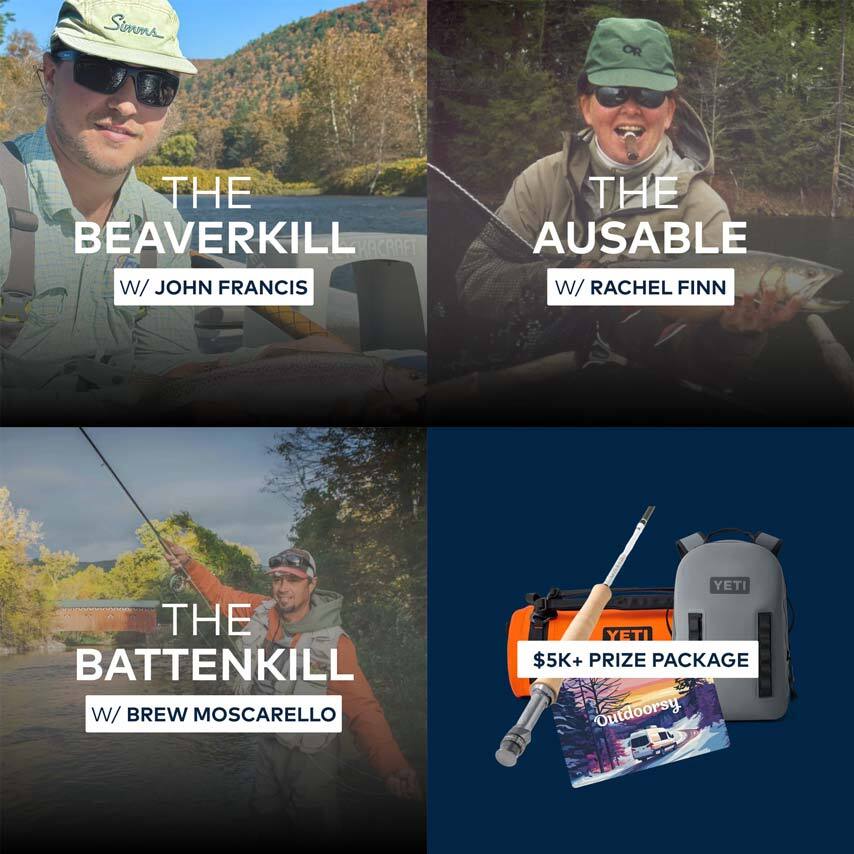
Whether or not you reside within the Northeast or not, there are three rivers you merely can’t go away off your historic fly-fishing bucket listing: the Beaverkill, Ausable, and Battenkill. Every of those rivers has performed host to numerous fly-fishing legends, from Theodore Gordon to Lee and Joan Wulff, to fashionable legends like Tom Rosenbauer. Actually, lots of the most prolific early-American anglers fished throughout all three of those areas (the Catskills, Adirondacks, and southern Vermont), and you’ll see the identical affect of those fisheries by way of groundbreaking fly tiers, rod-builders, and reel-makers.
To honor these hallowed waters, the American Museum of Fly Fishing (AMFF) is raffling off a fly-fishing street journey that you simply don’t to wish to miss. The journey contains three days of fishing for 2 individuals with three wonderful guides together with the one and solely Rachel Finn (star of “After You’ve Gone”); Orvis-Endorsed Information of the Yr finalist, Brew Moscarello, and Catskills-based information {and professional} fly-tier, John Francis. Additionally included within the profitable bundle is an Orvis Helios rod, a non-public reception and tour of AMFF (proper subsequent door to the Orvis rod manufacturing unit the place your rod was made), a water-resistant baggage set from Yeti, and an AMFF swag pack. Lastly, you’ll additionally get an Outdoorsy RV rental reward card, so it’s not a street journey in title solely. AMFF will even present coordination with guides to safe fishing dates of the winner’s selecting.
Tickets begin at simply $25, and all proceeds assist AMFF and the mission-critical work we do. Plus, buy 2 or extra tickets and also you’ll mechanically obtain a complimentary AMFF membership that features print supply of our award-winning quarterly journal ($50 worth).
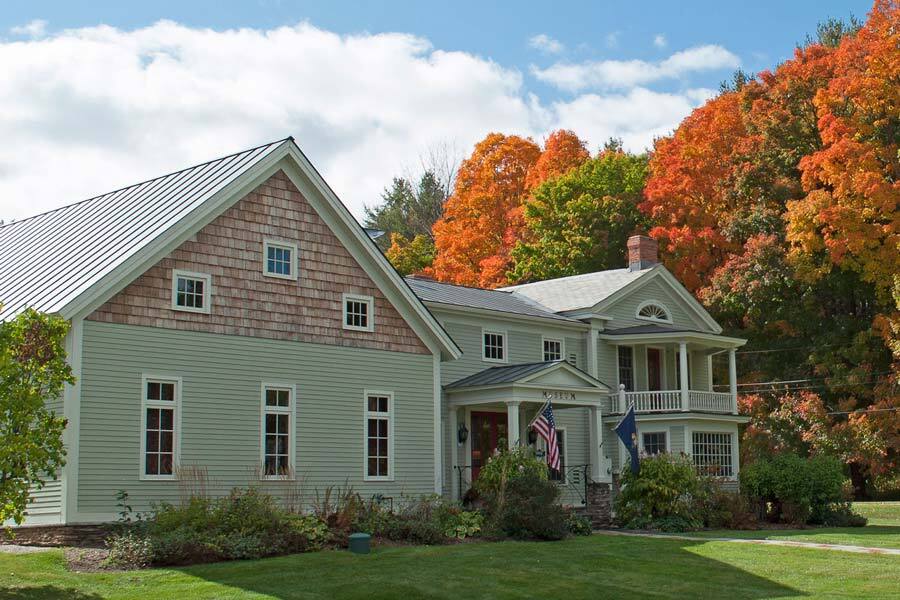
The museum, in Manchester, Vermont, includes a exceptional assortment of historic fly-fishing artifacts.
For greater than 50 years, AMFF been preserving the historical past behind the individuals, locations, and issues that matter to the game of fly fishing. AMFF affords a variety of program throughout two bodily areas (Manchester, VT and Springfield, MO) in addition to many remote-friendly applications together with our award-winning quarterly journal, The American Fly Fisher. To study extra about our mission, and how one can assist, go to amff.org.
“Within the dazzling gentle, underneath the sensible blue sky, each element of the magnificent forest was vivid to the attention: the good timber, the community of bush ropes, the caverns of greenery, the place thick-leaved vines lined all issues else.”
-Theodore Roosevelt, By the Brazilian Wilderness (1914)
A cocoi heron sails off into the magnificent forest.
Two weeks in the past, I led a bunch of Individuals into a bit of the Amazon Rainforest inside the nation of Guyana that I’ve had the great fortune to discover during the last a number of years. I’ve developed friendships with the Amerindian guides, realized their fishing tips, and listened to their ghost tales. What follows are my notes and images from this expedition 100 miles up the Rewa River from its eponymous village.
Day 0, Feb. 13
Mac and Dave arrived in Georgetown, Guyana, final night time and are headed to Ogle Airport en path to Lethem. Sam and Elizabeth will arrive within the capital tonight. I’ll be attending the premiere of “Shadow Folks on the Falls,” the F3T-selection movie I produced final yr with April Vokey and Jesse Males of Backwater Productions. About 30 hours after seeing it for the primary time on the large display, I’ll be again in that very same unusual nook of South America for a 3rd try at comprehension.
Day 1, Feb. 14
I left my Valentine at 1:00 am to drive to Billings to fly to Dallas to Miami to Georgetown. Our driver and capital connection, Eon, bemoans shedding fishing spots to the huge Exxon terminals arising alongside the Demerara River as he drives me from the worldwide airport to the lodge after 1:00 am. I’m asleep instantly.
Day 2, Feb. 15
Arising too quickly, I lastly meet Sam and Elizabeth on the buffet for breakfast. Eon excursions us via the town to the regional airport. Verify-in and safety provide the same old mixture of consideration and intransigence, and earlier than lengthy we’re crawling into the twin-prop for an hour-long hop to Lethem.
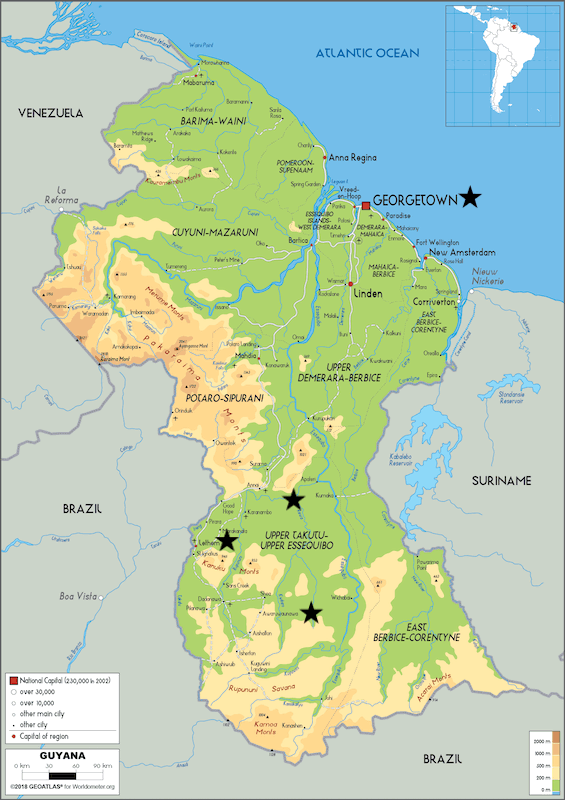
The Nation of Guyana is roughly the dimensions of Utah. Stars point out Georgetown, Lethem, Rewa Village, and Corona Falls.
The outpost of Chinese language wholesalers and open-air eating places on the Brazilian border surrounded by ranchland and savanna is 2 hours of tough gravel from The Oasis Restaurant and Annai, then you definitely’re into two-track. Our vibrant younger driver, Yousef Abraham, tells us that the cattle ranching stops round right here, someplace close to the place the jaguar territory begins. He’s labored in conservation and sustainable agriculture with the native communities round right here most of his grownup life—but additionally side-hustles exhausting together with his lifted, kitted Toyota Hilux. You want large knobby tires to get down the otter slide that’s the “street” to Rewa proper now.
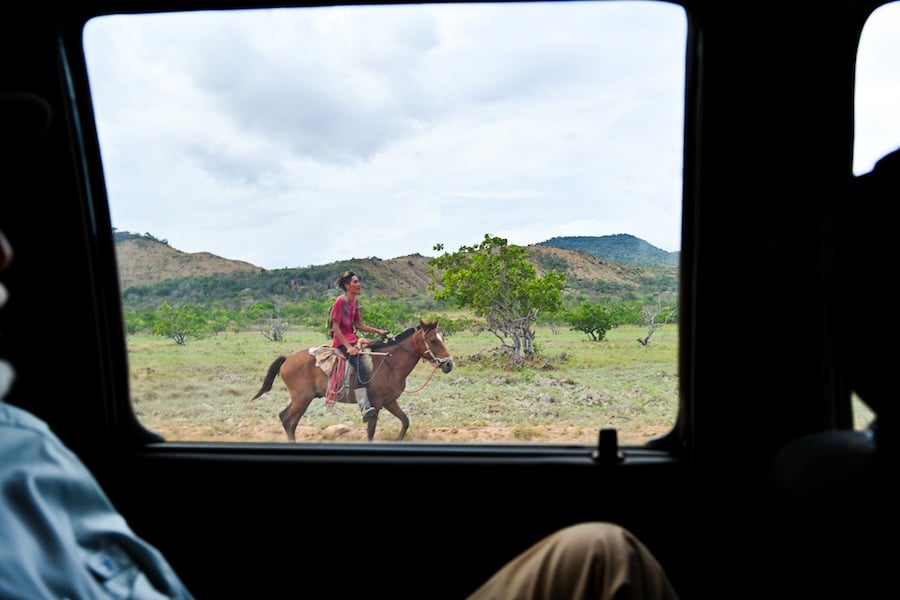
The savanna ranchland nation from Lethem to Annai is rarely wanting fascinating sights and modes of transport.
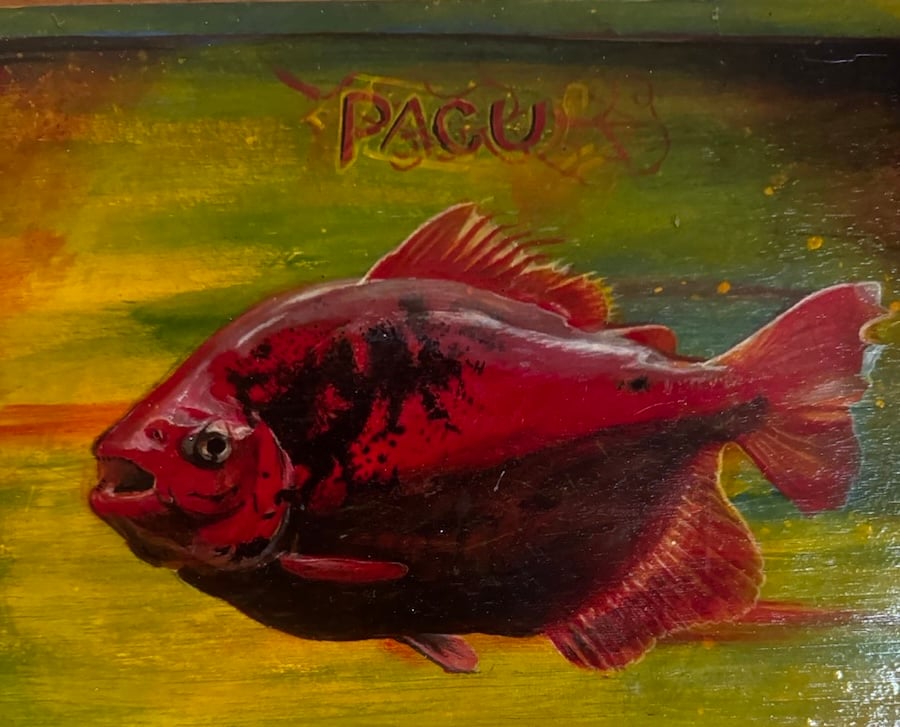
Two extra hours of 4-low crawling via the mud and there’s gentle forward on the touchdown. Yousef honks just a few occasions, hailing my good friend and Barefoot Adventures head information Terry who rips down from his dwelling simply up the Rupununi. He deposits us and our gear simply up from the confluence on the Rewa Ecolodge, the place we slurp chilly Itaipava and Banks beers earlier than pumpkin soup and fried arowana. Tiny bats roost in the principle lodge cabana rafters instantly above the octogenarian British girl on her jungle safari. I seek the advice of with artist and Indifly director Johann du Preez on on totally off-the-wall fly patterns and esoteric fish species habits earlier than retiring to mattress. The portray of a fiery pink pacu in my cabin can solely be a great omen.
A painted pacu on the Rewa Ecolodge.
Day 3, Feb. 16
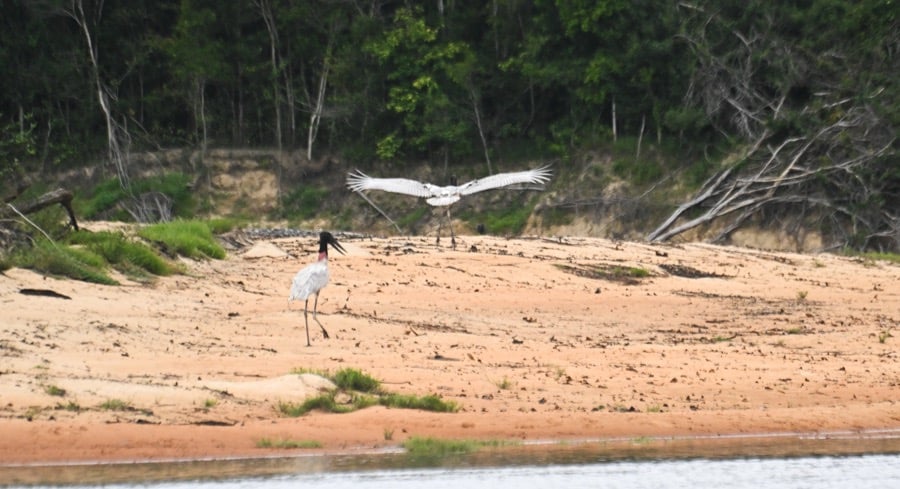
I load a fried egg and sliced sausages into to my puffy “bake,” a neighborhood specialty someplace between Native American frybread and Greek pita. We reload the bass boat and Terry blasts off upriver, relishing the rising waters. This journey took 5 hours two weeks in the past; now we’re taking a look at two because the sandbars fade from view. Jabiru storks elevate closely from an inside bend earlier than a rookery of nice egrets, then a congregation of spectacled caimans. Capybara scatter into the greenery, after which Terry eases to the financial institution to drop me off.
Jabiru storks alight on a sandbar.
I observe the jungle path outlined by perpendicular log rollers for boat dragging. Rising on the small lake, my eye first catches the large, contemporary wildcat prints among the many younger shoreline grass. A ship eases from round a nook. I discover a shady gap within the timber from whence to shoot pictures, rig a rod, and take a nap whereas Mac and Dave try and promote craft-fiber peacock bass to sunning arapaima.
Fly fishing for arapaima is a problem on par with tarpon or allow. Casts have to be fast and correct; strip-sets have to be sturdy and decisive.
Finally we rendezvous, hike out, and run upriver, slapping flies and lures into creek mouths and lagoons. Payara and black piranha are as playful as I bear in mind. Dave and Mac have already got these underneath their belts, in addition to arowana, peacock, a 100-pound-class redtail cat, and three smaller arapaima. I catch a pair of redtail catfish that night time whereas washing within the river and bullshitting with the guides.
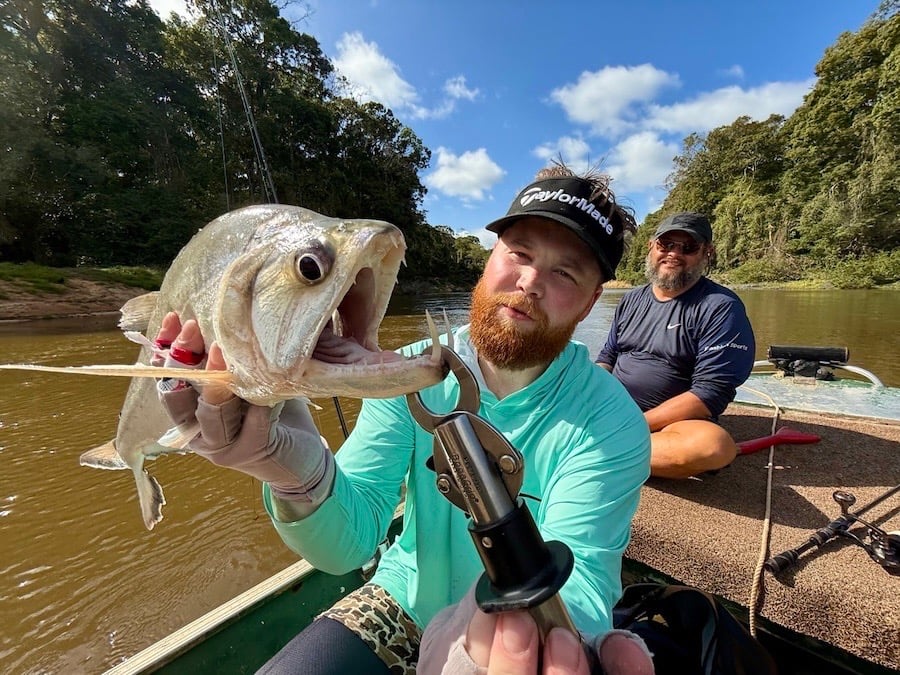
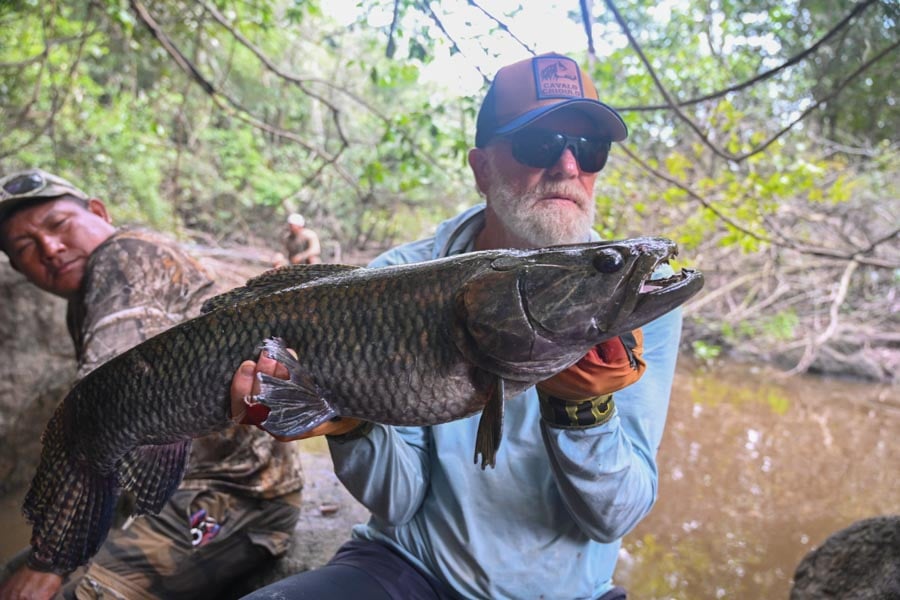
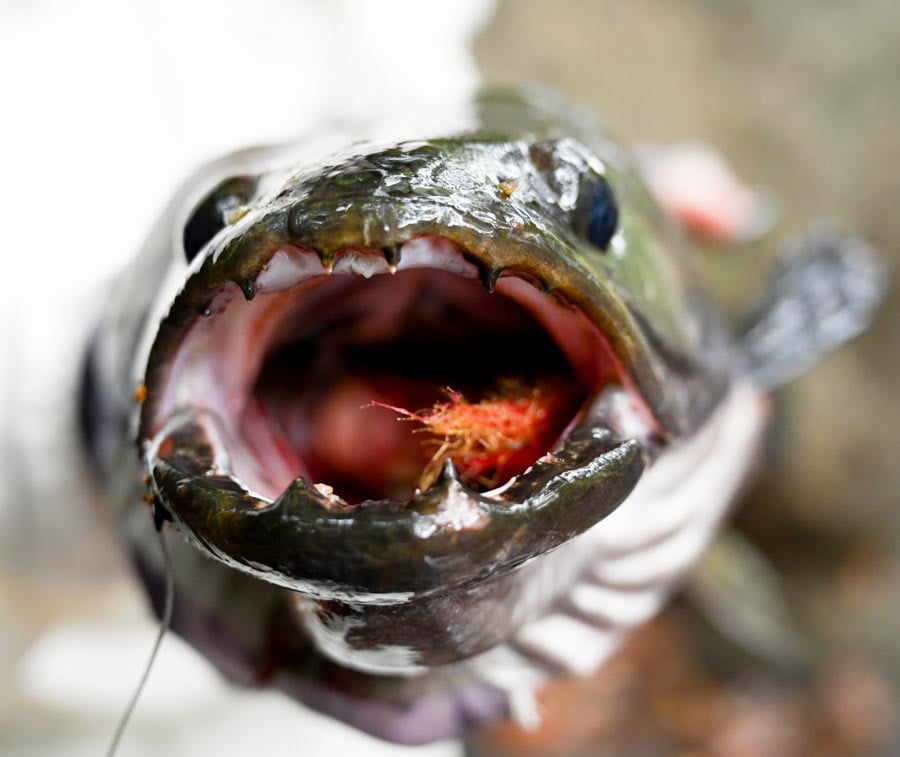
Payara or “vampire fish” have holes of their skulls that match their huge fangs. They’re among the many most enjoyable sportfish you’re more likely to encounter.
Day 4, Feb. 17
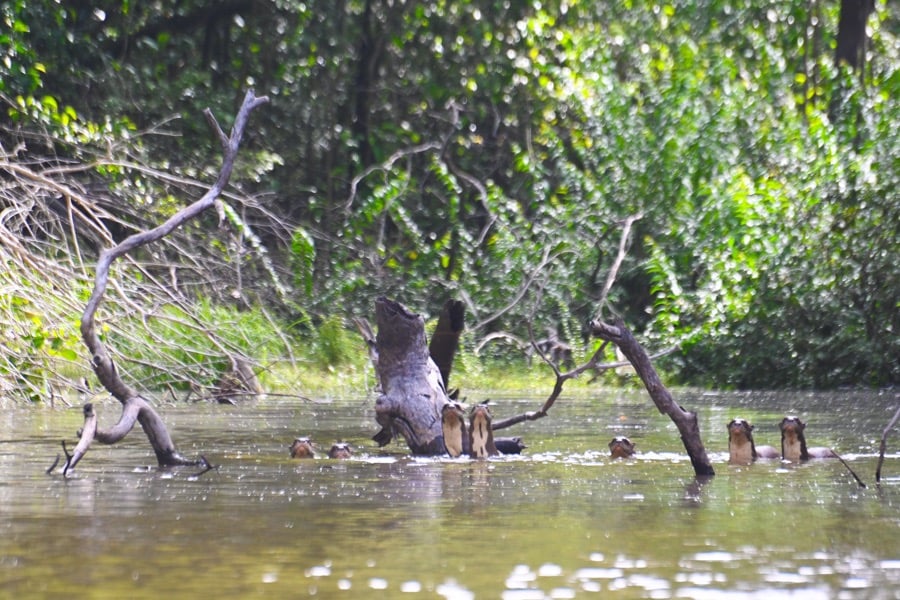
It’s good to be again in camp. The boys have clearly been exhausting at work build up the tarp construction and milling boards for a model new hammock home/cabin. They even carved an indication welcoming guests to Anteater Pool. After breakfast we head upriver, stopping briefly for a standoff with a gang of big river otters.
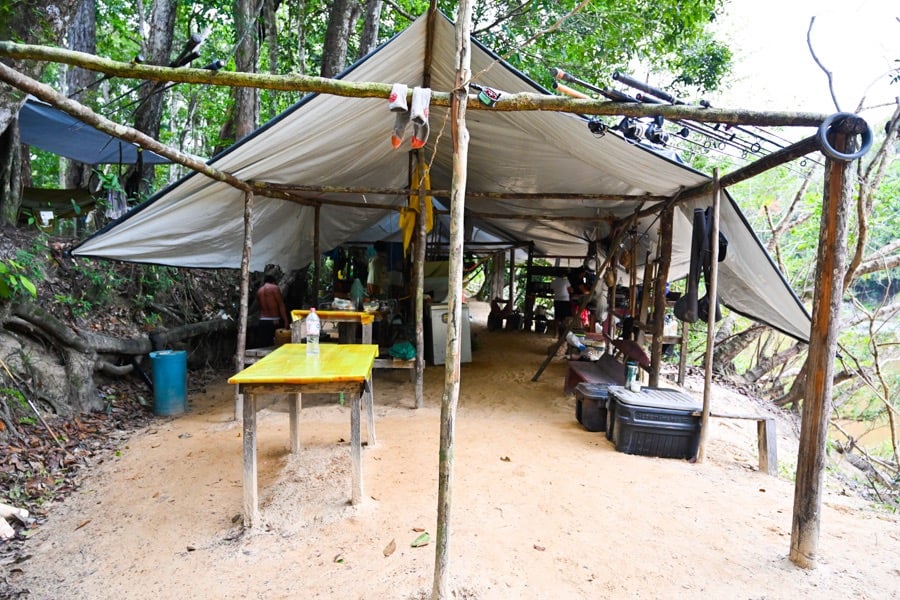
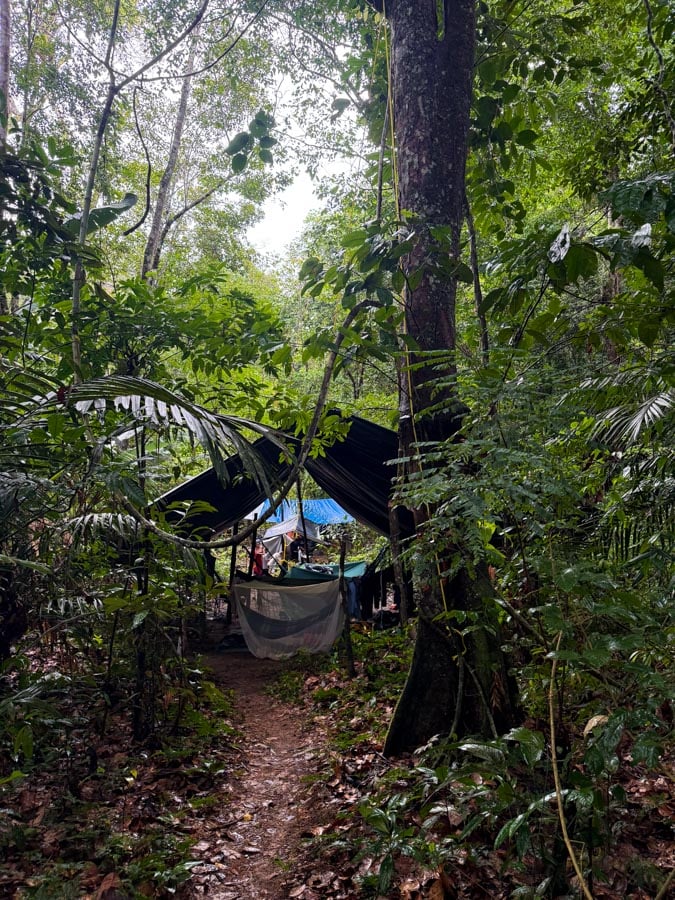
Anteater Basecamp is an ever-evolving wooden body and tarp construction some 40 miles upriver from the village.
Large river otters typically run in giant packs. They’re very curious and might be drawn shut by mimicking their calls.
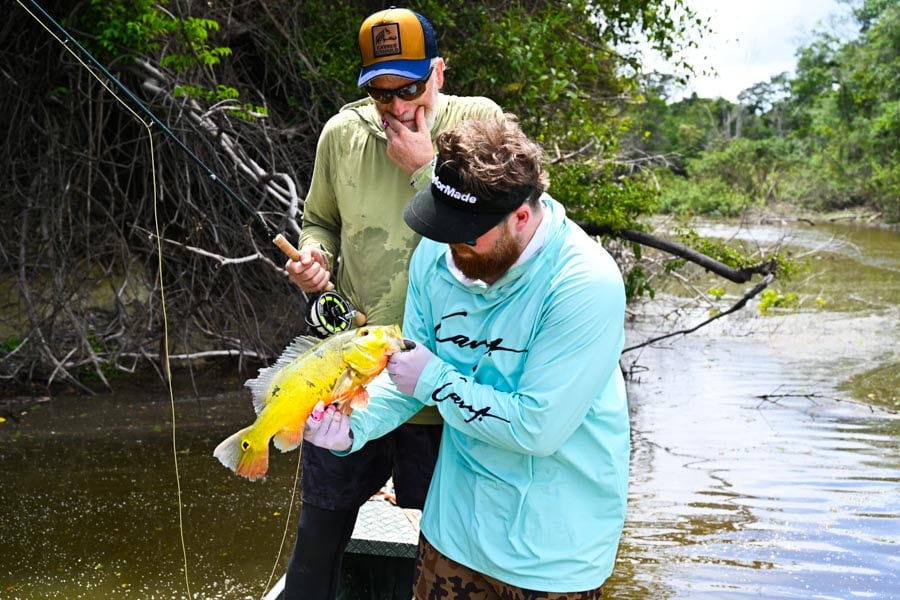
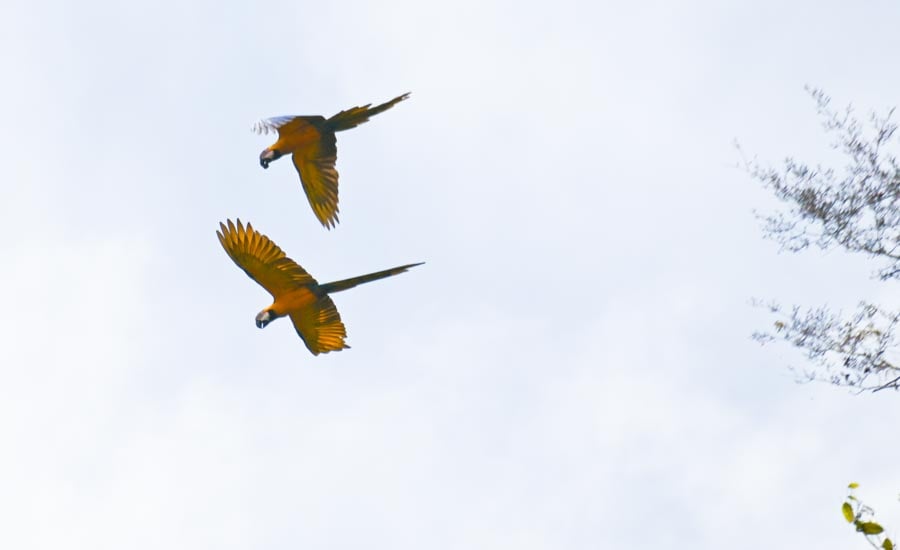
Again to the lagoon and Mac locks into a pleasant butterfly peacock on a popper. His 9-weight promptly folds simply above the cork and it’s a handline rodeo. I hand him my Winston, and we push via the neck and into the lake, angering extra inexperienced, yellow, and orange cichlids alongside the best way. Because the solar rises to scorching ranges we tuck into the shade to work on offering dinner. Blue-and-yellow macaws move screeching overhead.
Brilliantly coloured butterfly peacock bass don’t typically tolerate a popper passing over their lie.
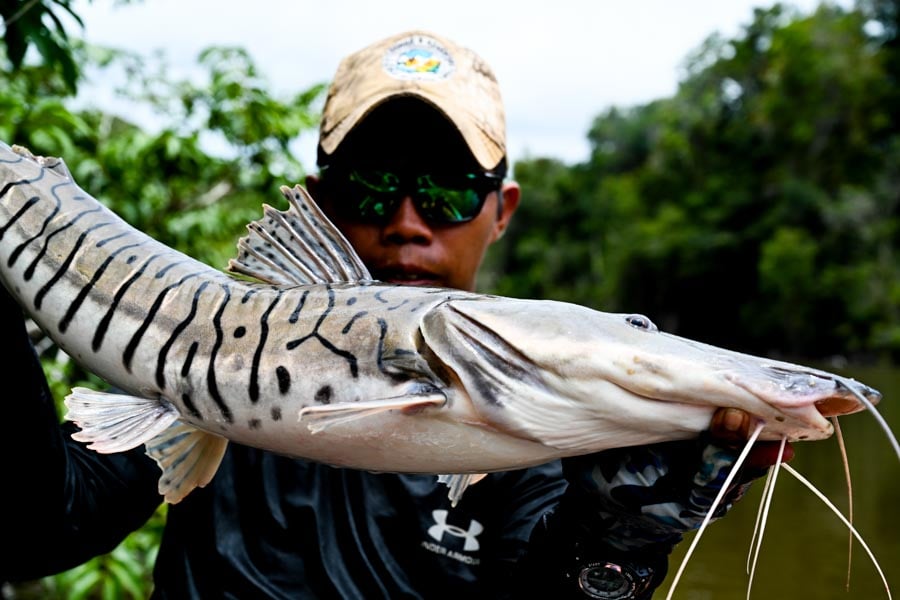
A tiger catfish every involves Dave and me, after which Mac is all of the sudden tied to an arapaima. It’s a manageable one—possibly 40 kilos—”the enjoyable variety,” I say. Bugs wrangles it shortly after just a few runs and tailwalks, an easier activity whenever you’ve educated on fashions ten occasions that measurement. Too quickly we now have to return to camp to see Mac off downriver for the African half of his journey.
Even a “small” arapaima typically takes two individuals to regulate.
Weeks in the past, Bugs and I had bartered a cellphone for a hand-carved fishing bow. We exit on the rocks throughout the river after dinner to coach me in its methods. I whiffed just a few good alternatives earlier than starting to correctly accommodate the sunshine refraction. It’s good to spend a while within the bullpen earlier than the ballfield.
Tiger catfish or surubi are plentiful and a staple of native delicacies.
Day 5, Feb. 18
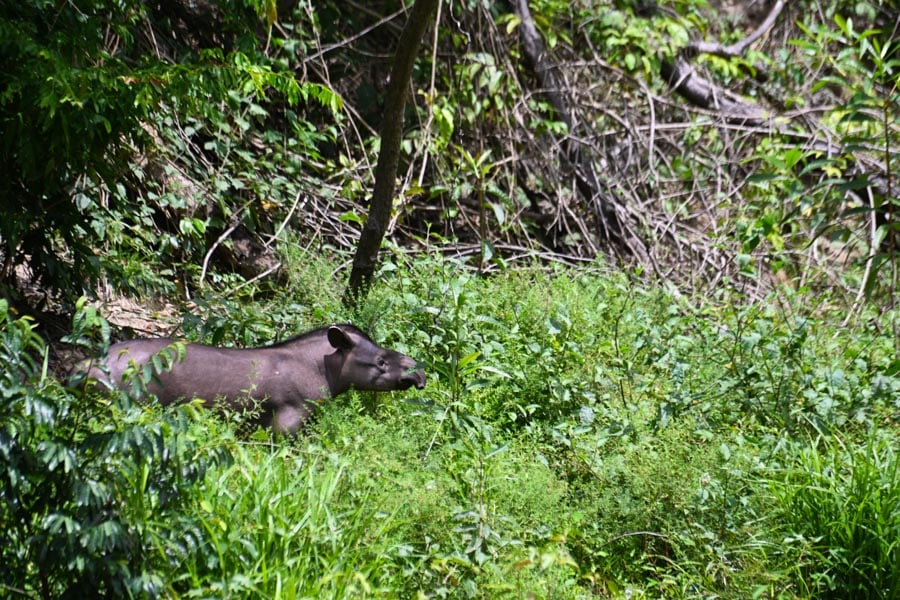
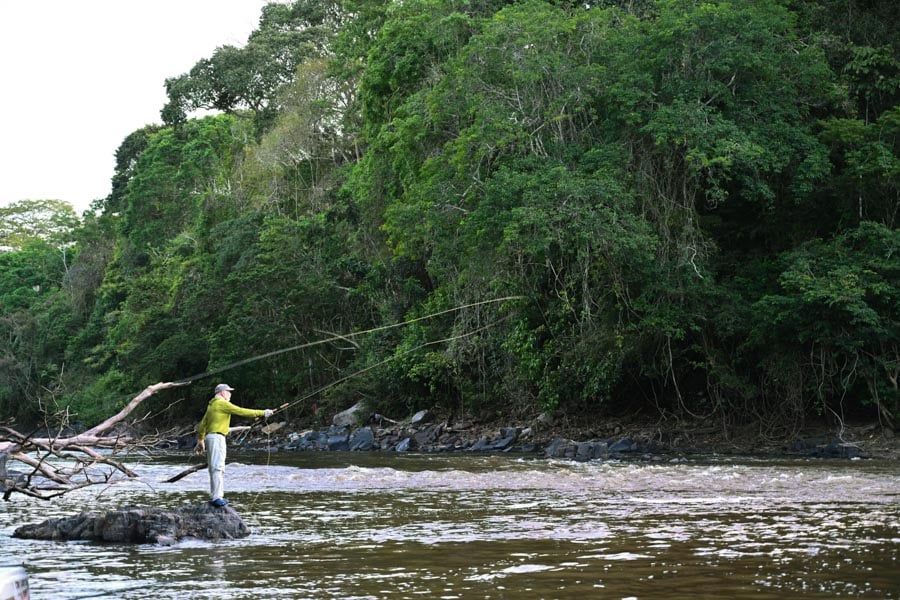
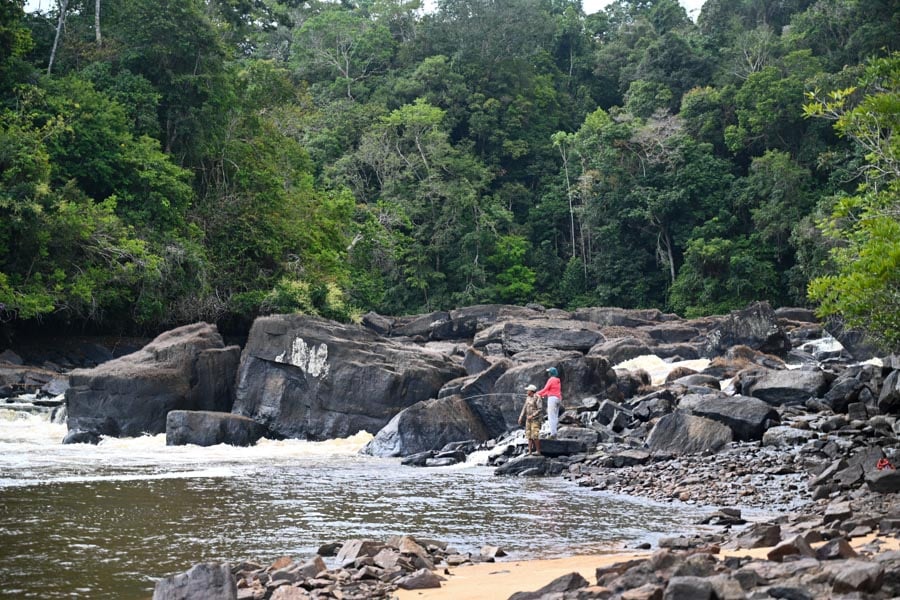
Camp packs up early and heads upriver in three boats, stopping at rocks and rapids alongside the best way to fly fish. Barely two hours’ journey time places us on the riverburst the place we’ve usually camped to entry the falls at decrease water. We eat lunch and push on, the river narrowing previous its confluence with the Kwitaro. An enormous tapir wades the shoreline vegetation as we start to enter the tailrace and terraced drops the place the river recovers from the violent Corona Waterfall.
Tapirs or bush cow are distant relations of rhinoceros that may develop to 500 kilos.
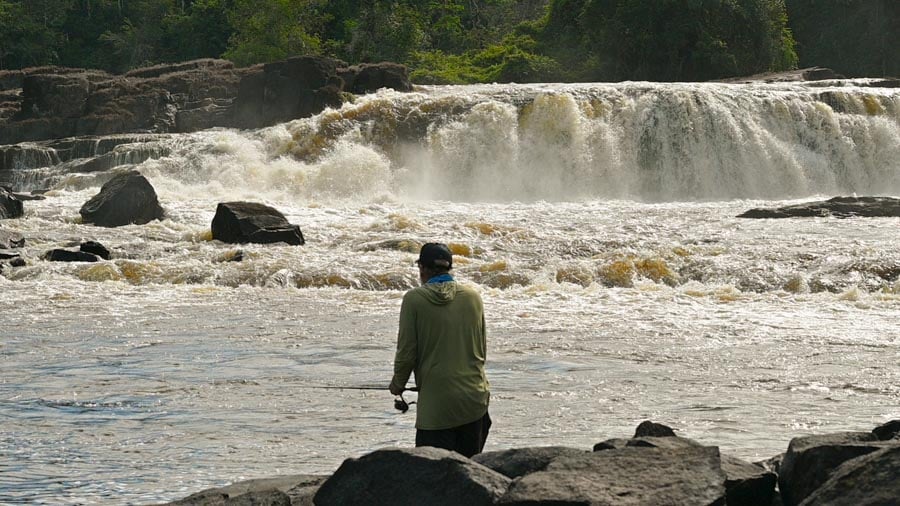
Captains pilot deftly up sluices and boulders to make land slightly below the primary actual vertical pour-overs. All boats offload and anglers transfer off to seek for dinner, the cooks towards arranging a spot to cook dinner it, and the crew hoisting tarps in opposition to the inevitable monsoon. We ascend river-right via the forest to a flat-rock apron opening to the broad wash of falls and adjoining lagoon. Dave lands a payara and I miss a bicuda, however the chew feels off within the rising water and baking solar.
Corona Falls is the primary in a collection of cataracts about 100 miles up the Rewa River from its mouth.
We adjourn to shadier locations to get severe about that dinner. With out refrigeration, the cooks didn’t convey any meat—so we’d higher discover some if we wish some. Elizabeth locks into just a few payara earlier than Stephanu involves ferry the couple again to camp at nightfall. I inform him to go away me there; we don’t have dinner but. A 35-pound tiger cat half an hour later solves that drawback, and I hail a journey.
Payara, bicuda, and pacu thrive round quick water on this system.
Day 6, Feb. 19
The crew spent a lot of yesterday night portaging two of the river canoes round Corona Falls. I’m ecstatic. We ran as much as the subsequent two units of falls—Powis and Cataback—on my first journey down right here and encountered plenty of pacu. I couldn’t catch one on that journey, or the subsequent one, and I’m out for blood this time.
Jungle camp at Corona Falls: arrange in just a few hours, damaged down in just a few extra.
Myleus pacu is one in every of many species recognized by that widespread title, a big herbivorous cousin of the piranhas. This Guyanese model sometimes runs a fiery pink or orange exterior made all of the stranger by its human-like tooth used for aquatic vegetation, berries, fruits, and flowers. The moniker “jungle allow” is evocative of extra than simply its dinner-plate profile. They’re extraordinarily shy, spooky, selective, enigmatic, and highly effective as soon as hooked. I’m carrying a collection of grassy, fruity, flowery flies made largely from Michael’s craft retailer discoveries and guided by obscure intel, hoping to lastly crack the code. The native guides have a specific curiosity in seeing us land a pacu past its distinction as a sportfish: they firmly imagine it’s additionally the tastiest fish within the river.
Blue-and-yellow macaws make a screech that’s as ugly as their plumage is gorgeous.
We hike the path from camp to the touchdown above the falls, load boats, and run a mile or two upriver to Powis Falls, extra of a chute actually—named with the native phrase for black curassow or bush turkey. No pacu noticed. Sam hooks just a few payara and piranha. Terry and Stephanu expertly pilot their craft up the torrent and we reload. It’s one other 3 or 4 miles to Cataback Falls, a jumble of house-sized rocks dropping the river possibly 50 toes in elevation earlier than washing into a large bay.
Cataback Falls, dwelling of petroglyphs and pacu.
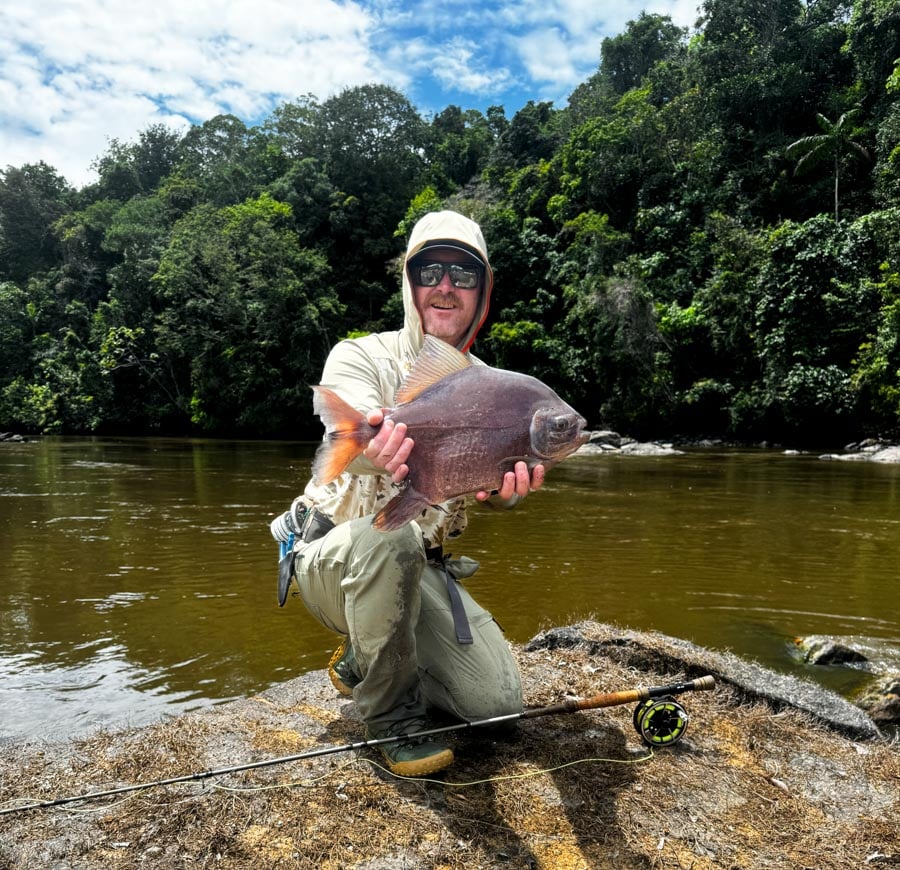
There’s much less water than final time I visited and no stream within the channel that was filled with pacu two years in the past. Sneaking up on the outflow, nonetheless, we spot three pumpkins holding tight to an inside bend. The group doesn’t present them adequate stealth they usually vanish. Whereas the shoppers fortunately strip streamers for extra predatory fishes, the guides ferry me throughout and we ascend the falls. Terry is carrying my spinning rod with the small gold Mepps spinner, a recognized pacu hack, so I do know he means enterprise. He factors me to a deep trough simply above the cataract, and I start to work via it with my craft-store concoctions. Then, on a protracted forged with a floating fuzz, a vibrant orange dinnerplate seems and rushes downstream after the fly. It grabs simply with its lips and I pause, ready for it to inhale. Head turns and I elevate again into the air, groaning loudly. Just a few casts later, the identical factor occurs—however this pacu inhales immediately. I sweep exhausting and the jungle allow burns out my slack line upriver, turns, then shoots down towards the falls, taking me round a boulder. I virtually fly out to the snag, get well pressure, and lock the drag. Trevor comes up behind me and I swing the beating fish to his arms. All of us begin war-whooping: me for checking off the one highest merchandise on my fish want listing; the guides as a result of they’re significantly thrilled in regards to the coming lunch.
The writer with a long-time aim achieved: pacu on fly.
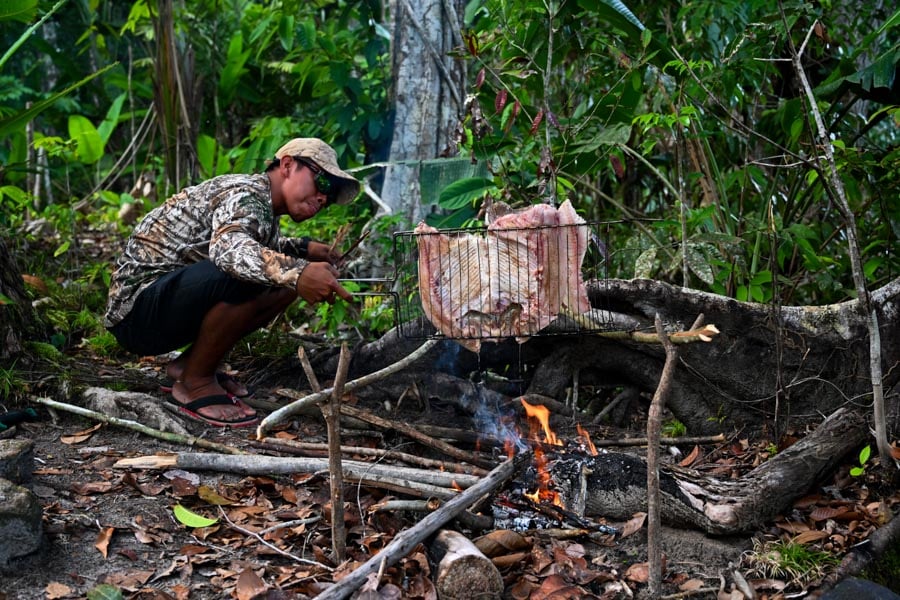
Again on the seashore under, the fellows spatchcock the pacu, sandwich it a fish grate, construct a fireplace, and sizzle. Laid out on a broad palm leaf subsequent to coconut crackers and the ever present Mambo Sauce, I’ve to agree that that is the most effective fish flesh within the river—possible in no small half as a result of it took me three years to catch it. After a soak and last session at Cataback we start to descend, working the logs and rocks unsuccessfully for aimara, the large wolf fish, the species now on the high of my listing.
Bugs with a short-term aim achieved: pacu for lunch.
Everyone seems to be weary and hungry once more by the point we trudge again to camp, and the cooks serve an applicable surubi feast whereas I carve everybody’s cocktail ice with a hatchet. Tireless as at all times, after dinner the boys ask if we’d prefer to go catfishing. The plunge pool across the nook from Corona is understood to host jau or gilded catfish of staggering proportions. As we stroll from the cook dinner tent to the boats, a big, wide-headed serpent slithers into our path. “Unhealthy snake, get again!” Bugs yells. Because the snake goes for the undergrowth towards the information’s hammock space, Stephanu comes up from behind and saws its head off with the 12-gauge. Labaria, they name it—lancehead or fer-de-lance, my later analysis yields—a violently venomous pit viper. Pleasure piqued, we run the large boat up and throughout and hike the path, encountering a tapir within the falling rain. Dave lands possibly a 45-pound redtail, however the chew feels gradual.
Redtail catfish emit a collection of croaks and grunts audible from a long way away.
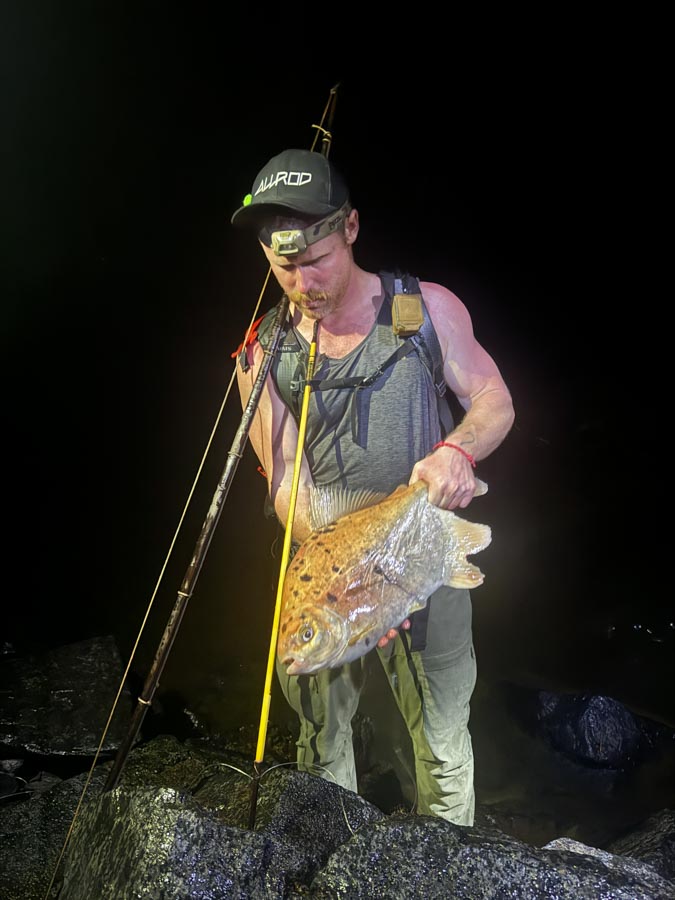
We stroll the rocks again to the boat an hour later and Demas spots a pacu. Everybody switches off their lights and the guides inch me ahead brandishing my fishing bow. Correctly located, Bugs tells me to attract then flicks on his highlight. I see the massive orange orb, intention down then upcurrent and launch. The arrow shaft detaches then jumps and we’re on the handline, reefing the skewered dinnerplate away from the chute under. Everybody falls to items when Trevor lastly grabs it, proving that they don’t actually give a shit about dry flies past what makes Individuals blissful—killing a pacu with bow and arrow is the true achievement for these Macushi/Wapishana tribesmen. We return to camp simply forward of a cacophonous, deluging rainstorm. I dream we’re sleeping underneath tarps instantly underneath the waterfall upstream.
Avert your fly fisherman’s gaze: that is what it means to go native down right here. And it’s method more durable than you suppose.
Day 7, Feb. 20
It’s time to start our 100-mile descent towards the village, and the boys have one other large day deliberate. They lately found a dependable spot for Hoplias aimara, also called hymara, traíra, or big wolf fish. No matter you name it, the demonic visage of this black-and-indigo ambush predator is as more likely to seem in your nightmares as your jungle hit listing. We attain the nondescript riverbank and start mountaineering, arriving some time later at a tiny trickle operating via rocks. Everybody slides down a steep financial institution to the water. We work flies and jigs across the fractured rock formations to no avail.
Small-stream wolfishing deep within the jungle.
The group disperses to work adjoining pockets, however the guides insist they’re right here. Stephanu sits proper on high of the rock in query, dipping Dave’s jig right into a crevice that appears barely capable of maintain an eel. All of the sudden, a large aimara blows out of the construction, tightens the road, and straightens the hook. I proffer a stronger metal and the scene performs out, this time with Stephanu tailing a 18-plus-pound wolf fish.
Ugly or ornate? The aimara or big wolf fish calls to thoughts lingcod and different spooky ambush predators.
Lastly I’ve my likelihood to see and {photograph} one in every of these really terrifying fish within the flesh. We’ve caught traírao, a smaller cousin, and I can personally attest to the bitch of their chew, however there’s nothing like the true factor. Ghoulish facial pores and skin wraps downward onto the few however fearsome tooth. Giant, reflective, darkish purple-and-blue scales taper again to spherical tail match for a a lot greater fish. The Halloween countenance and rock-pile congregation calls to thoughts the saltwater lingcod I grew up catching in Washington.
Dip your fly in the precise crevice and it could be consumed.
I catch one casting to that exact island, then Sam and Elizabeth each land their specimens dipping flies into the fissures. We poke round some extra earlier than clambering again to the boats for rum and lemonade on ice and fried paca, the 30-pound fawn-spotted rodent Bugs and Terry harvested the night time earlier than. Each hit the spot.
Day 8, Feb. 21
We made it again to basecamp final night time and celebrated our upstream adventures. Morning strikes slower, however earlier than lengthy we’re mountaineering into an arapaima pond, one in every of my favorites. Sam and Elizabeth pole round with Jules, Dan, and Trevor, sight-casting to the mighty fish as they arrive as much as breathe, whereas Dave, myself, and the remainder of the crew forged from a creek mouth. Everybody obtained grabbed or hooked to one in every of these swimming freight trains; nobody obtained to carry one. That’s all I need to say on the matter.
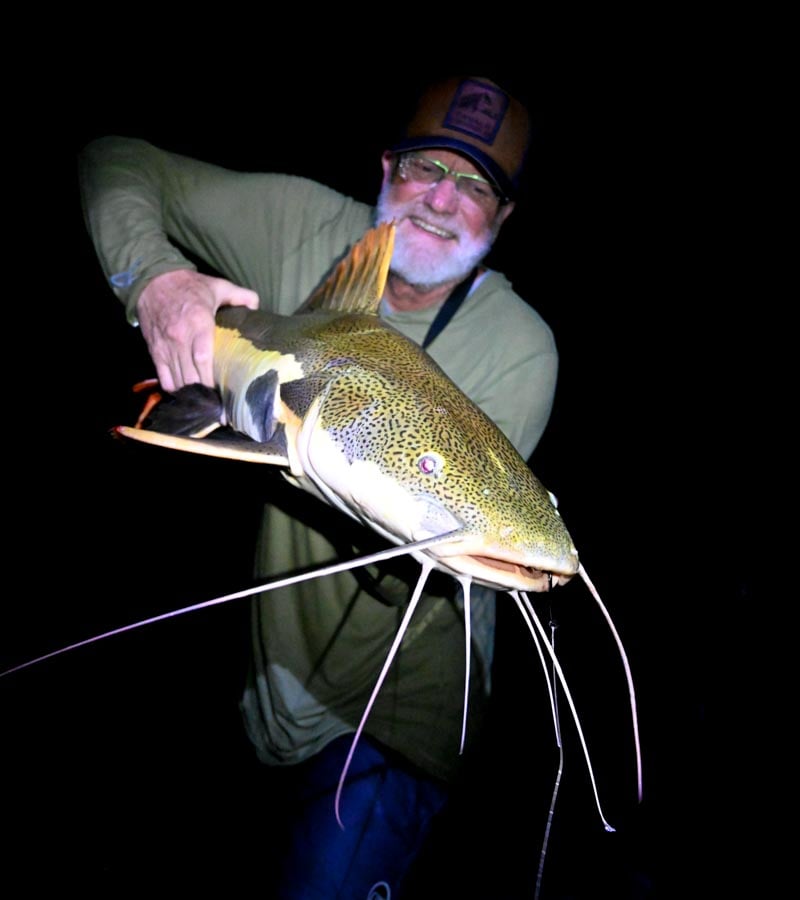
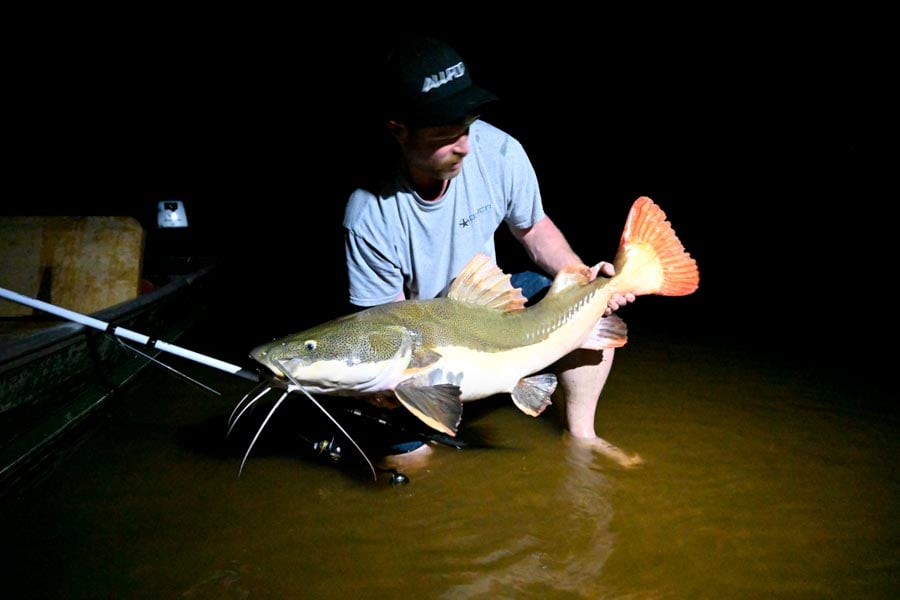
After dinner, Bugs gives to point out me the brand new catfish spot he discovered. He, Dave, and I run up there with out gentle and tie up. I lose an enormous fish straight away, then keep tied to a different. We hoist the 70-pound redtail aboard then search a shallower spot for footage. One other coveted achievement. The day’s failings are tempered.
The writer with a big redtail catfish caught simply above camp.
Day 9, Feb. 22
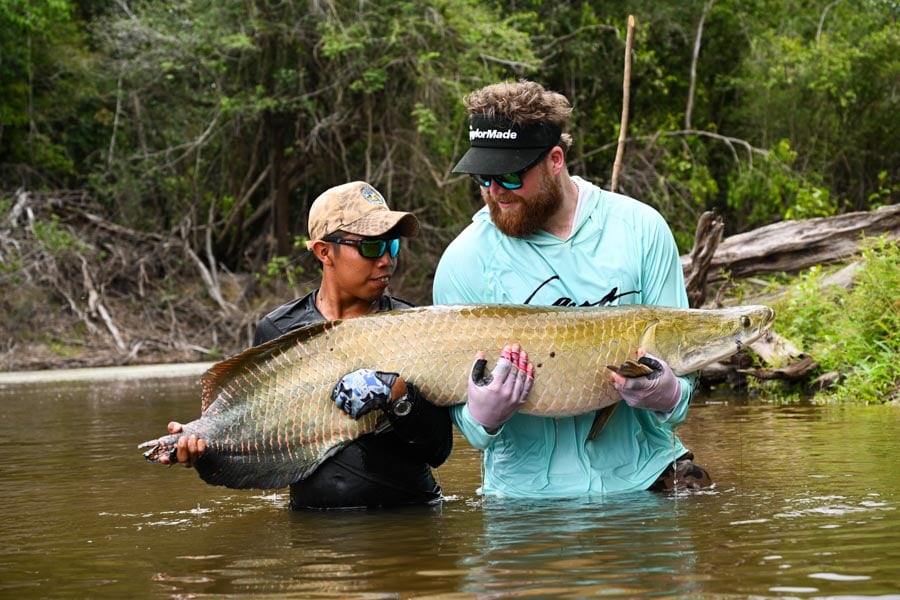
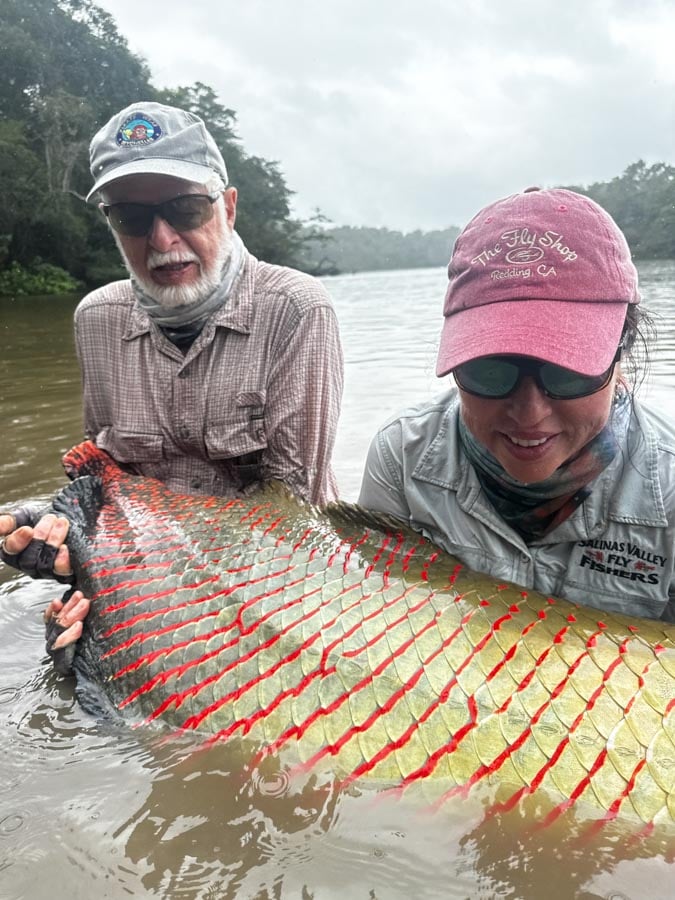
We return to the lake again within the jungle the place we left the boat yesterday and set about the identical recreation plan. Not lengthy into our session, Dave ties into one thing huge. The fish refuses to come back close to and refuses to tailwalk, an anticipated step in any arapaima dance quantity. After a collection of runs and jarring headshakes, the fish comes shut sufficient to Stephanu that he can contact the chief and pat the tail to encourage one other run. Dave hauls it shut as soon as once more, and our bronc rider saddles up, gripping the bony pectoral fin handles to glide with the fish. Then it decides to leap—straight into Dave, knocking him off his toes. We clear the road from deadfall and the warfare of tug is again on. Finally Stephanu will get a great grip and we now have it: Arapaima gigas, some 350 kilos or extra. There’s sufficient room alongside its flank for 4 of us to elevate it.
Arapaima are the biggest species of freshwater fishes on Earth that possess conventional scales. Solely sure sturgeons and rays develop bigger. This one was nicely north of 300 kilos.
Jules poles the boat with Sam and Elizabeth to watch the spectacle. It’s about lunchtime, in order that they be a part of us within the shade whereas Bugs grills a tiger cat we caught final night time—the final of that candy, fatty flesh I’ll get to eat for a while. Earlier than lengthy, line peels and we now have Elizabeth tied into one. She lands it deftly and with out a lot trouble, actually saying one thing with a fish almost twice her measurement. Sam fights, lands, and releases one other grownup arapaima not lengthy after, attaining some imaginary aim of catching and releasing 1,000 kilos of fish in a morning. Too quickly we hear Terry owl-hoot from the touchdown and we should depart. I bid farewell to my new associates Sam and Elizabeth, who’re taking the extra stress-free route dwelling, whereas Dave and I start our extra speedy retreat.
The comparability to dragons is simply too straightforward. Each angler is transfixed by their first arapaima.
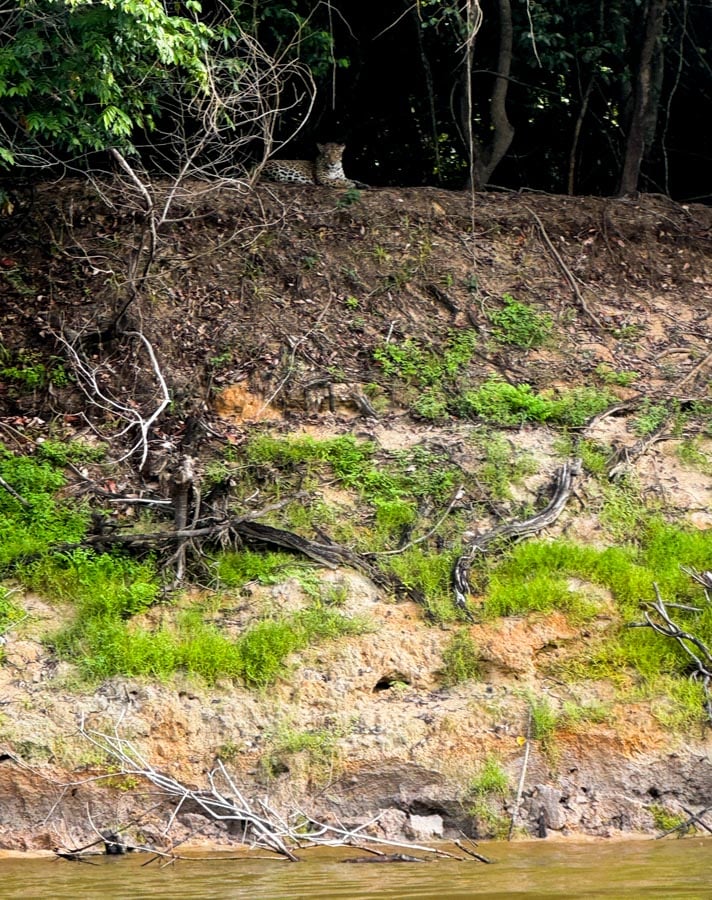
Because the skiff slides round a large bend on the blessedly greater water, I spot an oddly symmetrical lump on a excessive financial institution within the daylight. “Jaguar,” I gasp, pointing. The large cat, second I’ve seen in three journeys right here, regards us for a number of minutes earlier than hissing and taking depart to the jungle. We arrive on the ecolodge totally content material.
A jaguar surveys its area from a sunny shoreline perch.
Day 10, Feb. 23
Terry ferries us early from the lodge to the touchdown the place Yousef is ready to bounce us again to Lethem. Some Brazilian beef kills time whereas we wait to examine into our flight together with his uncle, after which we’re crusing into the sundown towards the Caribbean. Eon is out on a fishing journey, so his spouse Corinne taxis us from one airport to the subsequent. Safety workers make me query my need to return to this nation, however the bartender shortly restores it. Nigh on midnight we’re within the air to New York, then I’m onward to Dallas whereas Dave splits for Amsterdam en path to Africa. By 3:00 pm and with the assistance of a pleasant seatmate, I’m at dwelling in Bozeman. Lower, contaminated, bruised, bitten, and nonetheless watery from the malaria meds, I sit down, breathe deeply, and add one other merchandise to my packlist for subsequent yr’s journey up the Rewa River.
Sam Lungren is a author, producer, photographer, and MidCurrent’s Director of Manufacturing. Ship a notice to [email protected] when you’d prefer to study extra in regards to the 2026 Guyana expedition.
Despite the fact that fly fishing is a worldwide sport, I believe many people—myself included—neglect how a lot of an affect it has on different folks. It’s not simply the North American market that dominates fly fishing.
In reality, a current story from The Occasionsin London claims that “fishing, and specifically fly fishing” is Britain’s favourite sport and a “new youthful craze.”
The Occasions goes on to explain fly fishing’s maintain on Britain’s youth as follows:
“In distinction to the raucous and raunchy fare of TikTok and others providing clickbait to Gen Z, lingering movies of tranquil river depths and excellent rod casts are inspiring a brand new breed of social media influencer. From Premier League footballers to burnt-out clubbers, fishing gives aid to those that are anxious, depressed or in search of an escape from hectic city stress. And it’s cheaper than remedy or remedy.”
Maybe extra shocking is one other Occasions article, revealed Feb. 24 by Lucy Holden, about fly fishing’s “anxiety-busting results.”
Holden interviews Amie Battans, a “YouTube star” who posts fishing and nature movies. Battans talks extensively about why she thinks so many younger individuals are drawn to fishing, stating the way it helps get folks out of the hustle-and-bustle of the world’s busiest cities.
“Fly-fishing makes use of your entire senses — you’ve bought the contact of the water, odor of the water, you’re actively trying the place to throw the fly, feeling the depths and flows of the river … it’s an overload in one of the best ways,” Battans informed Holden.
Fly fishing has additionally been given a shiny veneer by a BBC sequence, the place comedians Bob Mortimer and Paul Whitehouse head round Britain on a fishing journey. Whereas many anglers are aware of Britain’s contributions to fly fishing as we all know it, there appears to be one other resurgence of British love and appreciation for the game.
At any price, each these current tales go to point out how wide-reaching an affect fly fishing can have.
Vacation spot journey is all the trend proper now. Instagram is crammed with photos and movies of anglers in far-flung locales, chasing unique fish on 12-weight rods, and usually having the time of their life.
I’ll admit, a little bit of jealousy creeps in after I see these posts. I’d like to be someplace heat proper now. As a substitute, I’m thawing out from a deep freeze that’s turned all the pieces into mud. No less than it’s not 20 under anymore.
So, in case you’re like me, and you’ve got Ferrari style on a Honda finances, particularly the place fly-fishing journeys are involved, it is best to learn this latest story from Todd Tanner in Hatch Journal.
Tanner walks you thru just a few ideas that will help you turn out to be a stellar angler, with out making the trek to the Amazon, Patagonia, Iceland, or wherever else. Sure, a few of these anglers fishing in these locations are unbelievable. Nevertheless it’s doable to turn out to be simply as completed as they’re, Tanner claims, by specializing in his ideas.
They embrace working in your angle, having a development mindset, selecting the right gear (not essentially the most costly), and spending as a lot time as doable fishing with dry flies. Dry-fly fishing will educate you a ton, Tanner says, “since you’ll have the chance to see all the pieces good, and all the pieces unhealthy, about every forged and every drift. Then you possibly can take what you be taught to your nymphing, and your streamer fishing, and your soft-hackle recreation.”
After 5 years and a couple of,823 posts right here at MidCurrent, it’s time for me to show the reigns over to somebody new.
I began with MidCurrent again in 2020, earlier than the pandemic. Marshall Cutchin, writer emeritus and then-owner of MidCurrent, employed me because the Information Editor. I used to be in command of discovering and sharing the goings-on of the fly fishing world.
If you understand simply how small a group fly fishing is, it’s exceptional that we generate a lot information. Roughly 8 million individuals fly-fished in 2023, the final 12 months for which information is obtainable. That features everybody who went on a single-day float whereas on trip, and the trout bums who clock near 300 days a 12 months on the water. Of these 8 million, let’s say half are invested anglers who repeatedly fly-fish, purchase rods, journey, tie flies, and devour fly fishing content material.
That 4 million individuals are so all in favour of new gear releases, public land battles, enhancing their abilities, tying flies, and conservation, is unimaginable. The variety of jobs our little group helps is frankly overwhelming, and I’m fortunate to be a part of it.
To all of the readers who repeatedly tuned in to MidCurrent for the previous 5 years—thanks. To everybody who left feedback (even the imply ones, as a result of they’re good for fun typically), thanks. Thanks for studying what I wrote, supporting the remainder of the MidCurrent workforce, and serving to us obtain our objective of being the go-to supply for fly-fishing information.
I’m additionally sincerely grateful for everybody who learn my gear opinions these previous few years. MidCurrent gave me the prospect to dig into gear greater than ever earlier than, and as a gear junkie with a major problem, it was unbelievable.
The remainder of the MidCurrent workforce has some unbelievable issues in retailer. This publication will probably be doing nice issues within the close to future, and I stay up for consuming all of it with you.
Hayden Creek Cutthroat trout have confirmed to be true survivors. Photograph: Colorado Parks and Wildlife.
One of many nation’s rarest trout subspecies is making a outstanding comeback in southeastern Colorado. As Chris Hunt experiences in Hatch journal, the Hayden Creek cutthroat was practically worn out by wildfire in 2016, however biologists have made a startling discovery:
A local cutthroat trout discovered solely within the Arkansas River drainage of southern Colorado, and as soon as on the point of extinction, is now reproducing naturally in waters the place it was reintroduced after a devastating wildfire worn out a lot of its native habitat 9 years in the past.
The final recognized Hayden Creek cutthroat trout—most likely most intently associated to Colorado’s state fish, the buck cutthroat trout—had been actually pulled from an energetic fireplace zone on Hayden Go in 2016 with a purpose to hold the fish from winking out altogether. Simply final fall, Colorado Parks and Wildlife biologists confirmed that reintroduced populations of the fish had been reproducing, and, extra importantly, they reported, the fish had reproduced a number of occasions since they had been reintroduced of their once-native waters.