The place I grew up, we referred to as them crawdads. I’ve heard them referred to as crawfish, however most people appear to decide on crayfish because the official time period for these attention-grabbing freshwater lobsters. No matter what you name them, crayfish are an essential a part of the food regimen for a lot of trout, particularly these dwelling in tailwaters. They’re a high-protein meals supply, and a few of my greatest fishing days final 12 months got here when fishing crayfish beneath a giant foam hopper.
Should you select to tie your personal crayfish, you’ll be in for a bit extra time on the vise than you sometimes spend with mayflies or midges. These are meaty flies, and lots of the patterns are sometimes advanced.
It can be difficult to know which crayfish sample to strive, since there are such a lot of of them. That’s the place this story, by Stephen Could over at Fly Fisherman Journal, comes into play. He picked the seven greatest crayfish patterns based mostly on their biology and bodily look, which is a superb place to start out. As Could notes, “many common flies aren’t nicely designed. Some flies have large claws popping out of the fly’s head and float or drift with the hook pointed down, able to snag the primary piece of particles it encounters. Regardless of this, crayfish are such an essential meals merchandise on many rivers, and fish see so few imitations, that they’ll hit a mediocre imitation with stunning regularity. When you begin utilizing well-proportioned crayfish patterns, your success will certainly improve, and you’ll at all times have a number of patterns in your fly field prepared for motion.”
His seven patterns are all ones I in all probability must strive, as they’re a bit extra anatomically appropriate than my go-to, which is the Zirdle Bug.
Might also particulars fish these patterns, as nicely. His article is a unbelievable useful resource for studying extra about these under-utilized flies, and I extremely advocate studying it, particularly if you happen to’re uninterested in tying mayflies, midges, and caddis.
Bob Quigley was probably the most influential fly tiers of his technology. Whereas he handed in 2012, his improvements in fly tying reside on, and proceed to affect fly design in the present day.
In a 2013 Fly Fisherman Journal article, Charlie Craven had this to say about Quigley: “(he) modified the form of technical dry-fly fishing. That’s a powerful sentence and an much more spectacular feat. He coined the now-common time period ‘cripple,’ and managed with that single phrase to change the best way many fly tiers have a look at patterns designed for technical fishing and flat water.”
The oldsters at Fly Fisherman Journal lately republished an article Quigley wrote again in 2008. This piece contains his high 14 fly tying ideas, and if there’s anybody we should always take heed to about tying, it’s Quigley.
The information embrace the best way to lower artificial hair and fur, utilizing Jungle Cock feathers to mimic eyes on streamers, and tying in parachute hackle. These are abilities all of us can work on, and it’s price your time to learn the entire story.
Again within the Nineteen Nineties, salmon and steelhead returning to the Columbia River Basin averaged simply over a million fish per 12 months, in accordance with Oregon Public Broadcasting. That features all 5 species of Pacific salmon, and steelhead. The present 10-year rolling common is 2.3 million fish per 12 months, which is definitely higher than virtually 30 years in the past, however nonetheless far under the historic runs for the basin, which noticed 15 to twenty million fish returning yearly.
Whereas there’s nonetheless a lot to do with the intention to preserve anadromous-fish populations, the 2025 winter and spring steelhead seasons look promising in quite a few areas.
The Idaho Division of Fish & Sport (IDFG) simply introduced that greater than 100,000 steelhead have crossed the Decrease Granite Dam, which implies the fish will probably be plentiful within the higher Salmon and Clearwater River drainages. The leisure steelhead fishery in Idaho ought to be wonderful this 12 months. Nonetheless, roughly 82,000 fish returning to Idaho got here from hatcheries, in accordance with IDFG. Hatcheries are identified to have a detrimental impact on wild-fish genetics.
In reality, as soon as hatchery winter steelhead have been outlawed on the Skagit and Sauk Rivers in Washington, wild steelhead returns jumped into the 8,000 to 9,000 fish vary, a rise from the common of simply over 6,000 in prior years.
Talking of the Skagit and Sauk—simply over 7,000 fish are projected to return to those rivers, in accordance with the Washington Division of Fish and Wildlife (WDFW). This quantity will enable a leisure fishery on these well-known rivers for the second consecutive 12 months. Each the 2020 and 2022 seasons by no means opened as a consequence of runs that didn’t attain the 4,001-fish mark required.
Nonetheless, the temper about steelhead feels optimistic proper now. The Northwest Energy and Conservation Council (NPCC), which works to protect salmon and steelhead all through the Columbia River Basin, set a aim for five million fish to return to the basin by 2025.
“Whereas the rolling common from the final 10 years remains to be about 50% decrease than the numbers that NWPCC want to see, it does level to success from conservation efforts alongside the river,” wrote Nika Bartoo-Smith for Oregon Public Broadcasting. “That many returning fish is an enchancment from the Nineteen Nineties when the common dipped to its lowest for the reason that starting of this system.”
Extra definitely must occur with the intention to guarantee the way forward for salmon and steelhead within the area, however a run of excellent seasons ought to be trigger for some optimism.
Years in the past, after I first discovered to tie flies, my dad confirmed me a caddis sample that he mentioned his father—my grandpa—invented. This explicit fly is a mashup of what a tier as we speak would label as an Adams and an elk-hair caddis, full with the wing. It has the Adams tail, however the flat, stubby physique of the caddis. You may hackle this fly with no matter you want, however my grandpa at all times used grizzly.
That fly is exclusive in that I’ve by no means seen one other really prefer it. Whereas I don’t know if it’s unique, it definitely stands out.
So, that begs the query: what makes a fly unique?
Dom Swentosky, over at Troutbitten, solutions that query in his newest submit. Is a fly “new” when it makes use of new-to-us supplies? Or does it have to be a very unique sample, a mixture of fur and feathers that hasn’t but hit the business markets?
Dom sums it up effectively when he says, “Fly fishing has been round lengthy sufficient that it’s simple to imagine all the pieces’s already been executed. It’s true, largely. And possibly all that’s left are variations on a theme.”
The tenth anniversary lineup of readers: (Again row L to R) Amanda Monthei, Bridget Moran, Greg Fitz, Jason Rolfe, Steve Duda, Will Rice, Jesse Lance Robbins, and Anne Landfield. (Entrance L to R) Jon Tobey and Nick Basaraba. Picture by Dave McCoy
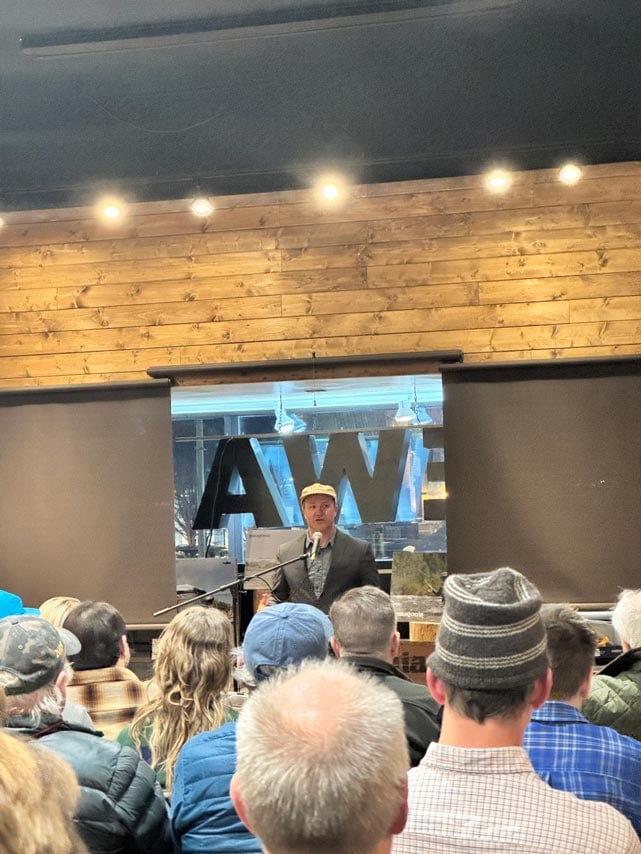
Frigid temperatures on Thursday, February 6, stored precisely nobody from attending the tenth anniversary of Writers on the Fly at Emerald Water Anglers in West Seattle. The celebration was additionally a homecoming, going down on the store the place it began in 2015. This system featured 9 hand-picked writers, who took turns on the microphone to share items of unique nonfiction prose and poetry centered across the sport. Whereas fish often appeared in some tales, essentially the most memorable moments touched on deeper themes.
The Phrase and the World
The brainchild of Jason Rolfe—one of many first workers employed by Emerald Water Anglers proprietor Dave McCoy—Writers on the Fly occasions have been held in additional than 30 totally different venues in Washington, Oregon, and California. The key of the occasion’s success through the years has remained the identical: the relatability and genuine really feel of each the works and their authors draw the absorbed consideration of listeners, no matter whether or not or not they fish. The tales shared will not be heroes’ journeys, however odes to the common human experiences of affection, loss, communing with nature, and letting go of what we are able to’t management. Authors shared treasured reminiscences of time spent on the water with family members, contemplations on why we fish, and the way angling shapes our lives, relationships, and philosophies.
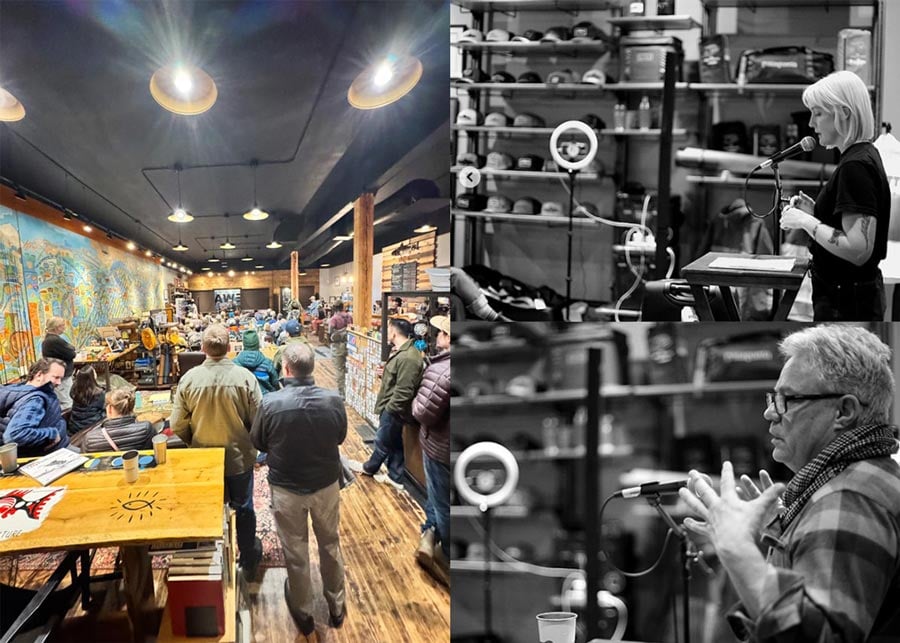
The place buzzed with a packed home and free-flowing beer on faucet. Dave McCoy and workers remodeled the area to accommodate a sold-out crowd, which ranged from seasoned anglers to literary fans. Attendees crammed each out there area, keen to have interaction with the profound connection between fly fishing and storytelling.
Left: The sold-out crowd was enthralled by the readings. Proper: Authors Bridget Moran and Jon Tobey introduced their phrases to life. Pictures: Lily Cutler (l) and Dave McCoy.
The night featured a various lineup of readers:
Will Rice: Identified for his explorations of distant fishing locales, Rice shared a bit that intertwined journey with introspection.
Amanda Monthei: A nomadic angler and author whose storytelling is knowledgeable by her experiences as a wildland firefighter and journalist, Amanda learn a narrative concerning the serendipitous encounters that are inclined to occur on the water and the way they usually result in lasting bonds that form and alter us in sudden methods.
Nick Basaraba: His narrative delved into the technical intricacies of fly tying, drawing parallels to life’s complexities and the pursuit of perfection.
Jon Tobey: Tobey’s evocative poetry and prose mirrored on the lack of a cherished companion, the impermanence of reminiscence, and the enduring solace of nature.
Jesse Lance Robbins: Robbins provided a lighter contact with a narrative humorously detailing the challenges of navigating a overseas tradition in Japan: “Biru Kudasai,” evoked the common feeling of being an outsider whereas on his approach to the water.
Steve Duda: The previous editor of The Flyfish Journal, Duda introduced picks from his current assortment, River Songs, mixing darkish humor with contemplative musings on mortality and the unpredictable nature of rivers.
Bridget Moran: Moran’s heartfelt tribute to a recently-passed shut relative explored the echoes of familial bonds and the therapeutic energy of water.
Anne Landfield: A information at Emerald Water Anglers, Landfield shared a number of items, together with an account of guiding a shopper who slipped and hit her head – a shaggy dog story that shortly dropped deeper into Landfield’s inside world as she associated her larger nightmares.
Greg Fitz: Fitz’s narrative wove collectively environmental advocacy and private reflection, emphasizing the accountability anglers bear as stewards of nature. Fitz rounded out the occasion with a bit referred to as “1-800-Beatdown,” bringing the viewers to rolling laughter as he learn out the choices for a hotline meant for steelhead anglers.
Sequence creator Jason Rolfe, who can also be the editor of The Flyfish Journal, displays on a decade of Writers on the Fly. Picture: Lily Cutler
Doing Good Work
Every WOTF occasion adheres to a easy but impactful format: a collection of readers and collaboration with a non-profit group. The tenth anniversary gathering was no exception. Proceeds from the night supported the YMCA’s Daring & Gold Out of doors Management Program, underscoring the neighborhood’s dedication to fostering the subsequent era of environmental stewards. Beneficiant raffle donations from supporting manufacturers like Fishpond and Patagonia provided attendees the prospect to assist a worthy trigger whereas celebrating the confluence of artwork and angling. The occasion additionally acquired assist from Loon Open air, Grundens, RIO, and The Flyfish Journal.
The milestone celebration was a joyful reunion of the collection, the store the place all of it started, and the neighborhood McCoy has tirelessly cultivated by way of a long time of labor bringing collectively anglers from all walks of life. Because the night concluded, conversations lingered, and so did the camaraderie. The tenth anniversary of Writers on the Fly not solely honored a decade of storytelling but in addition strengthened the enduring bond between fly fishing and the literary arts.
For these desperate to expertise future occasions or delve deeper into the collection’ wealthy historical past, extra info is accessible on the official Writers on the Fly web site, and to seek out out when and the place the subsequent WOTF can be held, observe the official Instagram account.
Lily Cutler has been fly fishing since age 14 and may’t keep in mind when she began writing. Her skilled work focuses on historical past, language, wellness, and human-centered applied sciences. She additionally paints, performs banjo, and nonetheless sends handwritten letters in cursive.
Oliver White is a famend fly fishing information who’s additionally made a reputation for himself touring to far-flung places looking for unique fish. You won’t know his title, however you’ve in all probability seen his face in various fly fishing movies, like “A Thousand Casts” from Yeti.
Ryan Chelius, over at Discipline & Stream, just lately sat down with White for an intensive Q&A. Their dialog ranges from White’s begin in guiding, to his current acquisition of the South Fork Lodge on the South Fork of the Snake River in Idaho.
Maybe probably the most fascinating tidbit on this story comes when Chelius asks White if he’d at all times deliberate on being a fishing information.
“I by no means supposed to be a fishing information,” White replied. “The plan was to go to regulation faculty once I was an undergrad. Then I bought a job at a fly store, not as a result of I wished to information, however to get some offers on fishing gear. The job ultimately segued into guiding.”
For those who put a gap in your waders final season and haven’t gotten round to fixing it but, you would possibly be capable to get it professionally repaired. The oldsters at Patagonia’s wader workforce are hitting the street this spring for his or her Wader Restore Tour, the place they’ll examine, diagnose, and restore waders, free of charge. And so they don’t should be Patagonia waders, both. Any model is welcome on the occasions, which occur in Colorado, Montana, and Utah.
Every tour cease can even function reside patching demonstrations, upkeep suggestions, and the prospect to attach with native organizations working to guard wild fish and clear water. Plus, you’ll get a sneak peek at Patagonia’s upcoming fly gear and revel in natural refreshments from Patagonia Provisions.
The tour dates are listed under, together with hyperlinks to RSVP for those nearest you.
FEB 21–23 | Denver, CO – The Fly Fishing Present (RSVP)
Streamer fishing is one thing I get pleasure from immensely, however I’m additionally responsible of not getting as a lot out of it as I may. I discover myself settling into predictable rhythms, retrieves, and going again to my tried-and-true patterns.
So, after I learn this latest piece from Dom Swentosky over at Troutbitten, I used to be reminded of how a lot I go away on the desk whereas streamer fishing. If I took the time to suppose critically about streamer motion and presentation, I’d seemingly see way more success.
“For me, streamer fishing is about how we need to transfer the fly,” writes Swentosky. “As a result of, as a substitute of attempting to excellent one factor, as we do with a useless drifted nymph or dry fly, the door is huge open, and inside is a giant assortment of actions — of displays — offering decisions for the way we would animate the streamer, give it life and trick a trout.”
Swentosky goes on to debate how essential the drop fee of a streamer is, or how shortly it sinks right down to the strike zone. This can be a idea I haven’t thought-about earlier than, however it’s value studying by means of if in case you have even a passing curiosity in streamers.
In the latest episode of the Orvis podcast, Tom Rosenbauer sat down with Mike Tayloe to speak about making ready for medical emergencies when out fly fishing. Tayloe is an EMT, fishing information, and wilderness drugs coach, so he has a wealth of expertise to attract from. Along with his expertise, Tayloe additionally educated Orvis-endorsed guides and lodges. He’s received a agency grasp not solely on the content material, however explaining it in a approach that’s straightforward to be taught.
That is the type of data you’ll be glad to have, however hope by no means to make use of it. Final fall, I used to be out fishing with a pal after I took a nasty fall. I slipped and fell headfirst about 10 ft down a steep riverbank, touchdown arduous on my hip and almost breaking my fly rod. After all, the very first thing I checked on was the rod (it survived) and I escaped with a couple of minor cuts and one deep bruise. If I’d fallen a bit extra, or simply to the fitting, there’s probability I might’ve damaged an arm. That have solely highlighted the necessity for the type of data Tayloe shares on this podcast.
There was some extent the place I tied flies religiously. 4 or 5 nights per week, week after week, yr after yr, I spun out sufficient flies to nearly make the entire thing cost-effective. The issue was that after I crammed my packing containers with the go-to patterns, I’d browse YouTube and Instagram for brand new concepts. At one level, I believe I had a dozen various kinds of mayfly emergers in my field, in all probability as many variations on the caddis, and loads of odd experiments that hardly ever made it onto my chief.
It’s not a foul factor to have loads of flies. I’d moderately have greater than I would like than not sufficient. Prior to now few years, although, my tying has slowed down considerably. I taught highschool English from 2022-2024, and that’s when my tying time just about vanished. I’d come residence from work too drained to do something apart from eat, play with the canine, and discuss to my spouse.
I’ve tied in suits and begins since then, often solely earlier than massive journeys, or once I’m utterly out of the naked necessities. I’ve purchased extra flies up to now two years than I ever have (I grew up in a household of fly tiers, so I hardly ever purchased any when studying to fish), and it’s felt—properly, odd, to make use of so many flies I didn’t tie. Nearly like I swiped another person’s pockets.
The upside is that I’ve significantly pared down my fly choice. (Fly store flies ain’t low cost.) The place I beforehand used a dozen emerger patterns, I now have three. A few of the flashy caddisflies are tempting, however I follow two elk-hair varieties, and catch sufficient fish to remain joyful.
The issue is, as soon as issues thaw out round right here (it was -18F final week, and it received’t get above single digits till Thursday), I do know I don’t have sufficient flies to reap the benefits of the spring season that’s quick approaching.
My packing containers are a tragic sight proper now, particularly with the primary blue-wing hatches proper across the nook. I’m out of emergers, measurement 16 Adamses, and right down to my final half-dozen Zebra Midges. I believe I’ve one Elk-Hair Caddis, just a few Frenchies, however I don’t have any Pat’s Rubberlegs. I do know I’ve two scuds, as a result of I purchased some the final time I went fishing.
It’s nearly like I’ve burned out on tying flies. It’s not that I dislike it, nevertheless it’s turn out to be extra of a chore than a inventive outlet. I used to get pleasure from stacking elk hair, spinning dubbing, and wrapping hackle. Even with a brand new tying bench, chair, and mild, I’m having a tough time discovering the motivation to tie.
Have you ever ever felt like this? What did you do to interrupt out of the funk? I’d love to listen to some dialogue, and hopefully some concepts to inspire me earlier than spring fishing is absolutely upon us.