You’ve in all probability been listening to lots about threats to public lands in latest weeks, as Congress has been debating whether or not or to not unload federally owned land to the states. Properly, Kirk Deeter of Angling Commerce has some fairly robust opinions about this concept:
[W]hat units the American angler other than virtually some other on the planet is that we’ve hundreds of thousands of acres and hundreds of miles of fishable streams (and lakes) which are accessible to us as a birthright. I’ve fished all around the globe and have loved each minute of doing so. However what makes my soul crammed with pleasure is the conclusion that, as an American, I share possession, and have entry to extra locations than anyone particular person may endeavor to fish in a lifetime.
Mike Connor caught this redfish with a custom-made 7-foot, 10-inch fly rod. Photograph by Mike Conner
The usual 9-foot rod works wonderful for many saltwater purposes, however writing in Florida Sportsman, Mike Connor makes a convincing case for utilizing shorter rods in particular conditions. A brief rod may be mild, quick, and correct for once you’re making an attempt to solid in a decent hall, tuck a fly beneath the mangroves, and so forth:
I’ve owned and fished rods from 7-foot, 4-inches to 8-foot, 4-inches in cramped quarters, equivalent to mangrove creeks—typically tunnel-like—within the Everglades, that snook and child tarpon name dwelling. Casts are usually shorter than 50 ft, and name for accuracy, and that’s the place brief rods excel.
I discovered early on that the relative stiffness of shorter rods helps with loop management, too. And casters with good casting fundamentals can solid extra slim loops which helps buck a headwind.
Preserve Fish Moist—a science-based nonprofit devoted to serving to anglers enhance the outcomes for every fish they launch—has launched a cool “Mini-Lesson” about finest practices for catch-and-release fishing. The Mini-Lesson is a good way to be taught the science behind catch-and-release, and it’s an incredible instructing software for explaining the method to others.
“Breaking down limitations to entry and sharing is on the core of Preserve Fish Moist” says Sascha Clark Danylchuk, Government Director of Preserve Fish Moist. “The brand new Mini-Lesson provides everybody the sources to share and educate about science-based finest practices for catch and launch.”
The digital model of the Mini-Lesson, together with lesson plan materials, is out there without spending a dime by signing up on the Preserve Fish Moist web site. Supplemental materials can be accessible quickly on the web site for a nominal payment.
This week’s Tying Tuesday contains a Catskill’s traditional dry fly, a extra trendy emerger from the thoughts of René Harrop, and easy but vivid moist fly, and a buggy nymph from Austria. Though based mostly in Missouri, Andy’s Flies clearly appreciates the slender, elegant patterns of New Yorker Theodore Gordon, and this Ginger Quill will definitely tempt mayfly-eating trout. (Catskills might have some nits to choose, however the trout don’t care.) Subsequent up is a cool little emerger that appears like a little bit of lint or sweater fuzz, however the CDC looped wing turns into translucent and typically even holds bubbles which provides the sample a really real looking look within the water. Tier Hogan Brown claims that this sample has “saved his bacon” as a information through the years.
For people who like a bit extra bling, the Black & Inexperienced is a straightforward, Woolly Buggerish concoction that’s positive to garner consideration from all kinds of species, from trout to panfish. Information Steve Cullen has nice luck with this fly within the English Midlands. Lastly, Austria’s Mountainfly Fly Tying serve up a jig nymph that simply seems to be like trout meals. SOme of the supplies could also be out there solely in Europe, however they’re straightforward to substitute with homegrown stuff.
Yesterday, saltwater fly-fishing icon Stu Apte celebrated his ninety fifth birthday. One of many pioneers of catching tarpon on a fly, Apte constructed a reputation for himself by feats of angling heroics (together with 44 world data) and limitless self promotion. We posted an excellent profile of Apte by Jim Chapralis again in 2011:
Stu Apte’s angling philosophy calls for the highest quality deal with rigged to one of the best of his skill in order that he can strain a fish to the gear’s max or close to max when crucial. When he’s critical about his fishing, he makes each forged, each presentation, each retrieve as if there’s a world document fish able to hit his lure or fly. He admits it’s arduous to maintain up the depth, however that’s what he tries to do when he’s in that “zone.”
To have fun Apte’s birthday, try the nice video above, and take heed to his look on Andy Mill’s Mill Home Podcast beneath.
Earlier this week, Trout Limitless launched a brand new movie, “Horses and Highwater: Restoring Tincup Creek,” documenting the restoration of the Salt River Watershed and the individuals who made this unimaginable mission come to life.
Positioned in northwest Wyoming and southeast Idaho, the Salt is a blue-ribbon fishery for native Snake River cutthroat trout and wild brown trout. Nevertheless, its well being has been compromised by degraded and fragmented fish habitat, speedy improvement in riparian areas, impaired water high quality, and dewatering.
“At its coronary heart, Horses and Highwater is a conservation movie, but it surely’s additionally about neighborhood, character, love for the land, and dogged Western willpower to discover a option to get issues finished,” mentioned Tanner Belknap, Salt River Undertaking Supervisor for Trout Limitless (TU). “The continuing restoration efforts at Tincup Creek exemplify the unimaginable partnership between Trout Limitless and Caribou-Targhee Nationwide Forest – amongst many different companions like Wyoming Conservation Corps crews, grazing permitees, and volunteers – to carry these tasks to life.”
Featured within the movie are two Tincup Creek stream restoration tasks, each of which aimed to reconnect sections of Tincup Creek to its floodplain. The movie focuses on the North Fork Tincup Creek Course of-Primarily based Restoration Undertaking, accomplished in 2024. This mission used groups of draft horses and Wyoming Conservation Corps crews to put in log constructions within the creek to seize cobble and sediment mobilized throughout runoff and lift the elevation of the streambed to enhance floodplain connectivity.
Elevating the stream will reconnect it to its floodplain to enhance stream perform, scale back erosion, and enhance habitat circumstances. These efforts will improve riparian circumstances and habitat for Yellowstone cutthroat trout, northern leatherside chub, boreal toad, western pearl shell mussels, and bluehead suckers – all of that are native species with particular administration emphasis. The movie additionally pays homage to the primary main TU and Caribou-Targhee Nationwide Forest restoration mission on Tincup Creek, accomplished in 2019, which totally restored 5 miles of Tincup alongside the filth highway part of the creek.
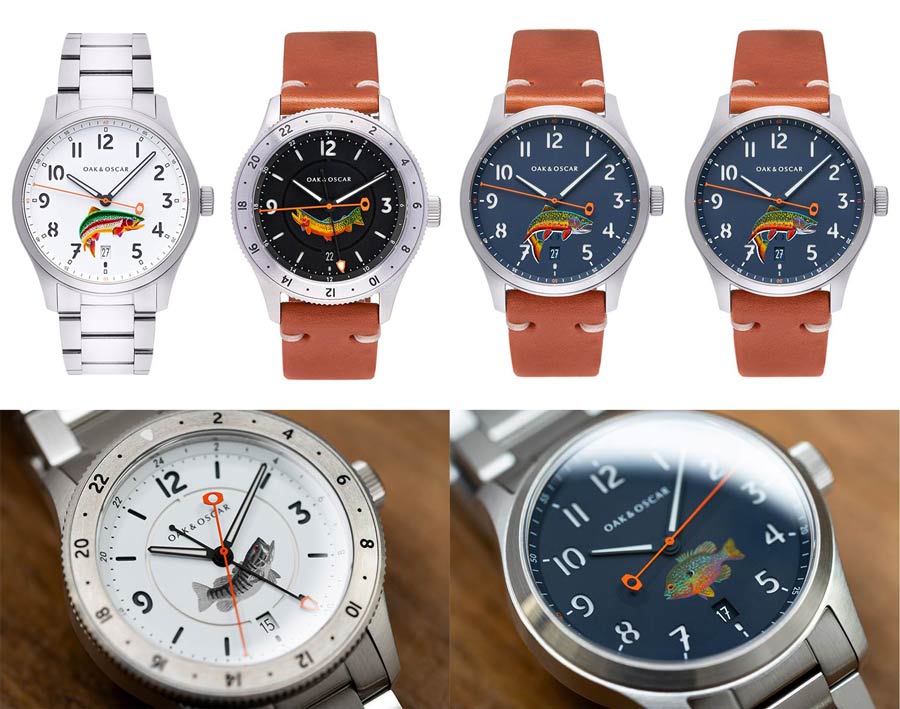
Do you’re keen on fly fishing and effective timepieces? If that’s the case, try the exceptional Olmsted and Humboldt GMT watches from Oak & Oscar, a Chicago-based firm celebrating its tenth anniversary in 2025. On the sport-specific web page of their web site, they proudly declare, “We’re an American watch firm . . . with a fly-fishing drawback.” That is particularly evident of their customized trout dials, painstakingly created by artist Tim Johnson (whose great burned-cork “Timmy Grips” you’ll have seen). It takes Tim eight hours of portray utilizing a microscope and a tiny, single-bristle paintbrush to create a fantastic portray that makes every timepiece distinctive.
Customized fish dials, by artist Tim Johnson, can be found for customized orders.
The watches themselves are constructed to final, crafted with precision and high quality components. With a sturdy stainless-steel case, loads of water resistance to face up to a chilly trout stream, and the right mixture of Swiss precision with American know-how, these mechanical watches are constructed to go along with you on all of your adventures. They aren’t cheap—starting from $1,575 to $2,175—however they’re constructed to be handed right down to future generations of anglers.
This brown trout is clearly wild—stunning, feisty, and enjoyable to catch—but it surely lives in a river the place it competes with native brook trout. Photograph: Phil Monahan
Fly fishers have lengthy created a hierarchy of trout within the U.S., based mostly on nature. On the prime of the pyramid are native species, caught within the waters they’ve inhabited for millennia; subsequent are wild trout, born within the river by pure propagation; and on the backside are stockers, fished reared in hatchery and planted for anglers to catch. However over the previous 140 years, lots of these stocked populations have change into wild, and plenty of of these wild populations compete with natives.
Writing in Sports activities Illustrated, Jasper Taback, discusses the problems raised by this dilemma, in addition to some doable options:
When brown trout had been launched to the USA within the late 1800s, the aim was to supply extra sport-fishing alternatives. It labored – brown trout have unfold all through the nation, boosting leisure fishing alternatives alongside the way in which.
Sadly, their unfold, together with the stocking of rainbow trout in non-native waters, has contributed to the decline of our native trout populations. The injury has been executed – non-native trout are right here, and in an enormous approach. So now what?
The lowly fallfish has been disappointing trout anglers for many years. Picture by Jim Leedon/Hatch Journal
Though there have been massive modifications during the last 20 years in how fly fishers view “trash fish,” there are nonetheless loads of species for whom we really feel little romance. In Hatch Journal, Steven Sautner asks why we really feel this manner:
Amongst anglers, fallfish virtually universally disappoint. Their largest offense is rising like trout and tricking you into casting for them. Any similarity ends with the hookset. After a languid head shake, adopted by an anemic run that will pull inches, not yards, off your reel, they yield to your awaiting hand with little fanfare. Twist the fly free, they usually typically gurgle at you earlier than the discharge. In a number of a long time of fishing the Delaware, I’ve by no means heard anybody excitedly exclaim: “Oh wow! A fallfish!” This can be why a buddy calls them failure-fish.
The good Tom Rosenbauer is on the opposite facet of the podcast equation this time, as he chats with Hayden Sammick of Backcountry Manifesto about how of us can get began in fly fishing. In typical Tom trend, he seeks to interrupt down limitations and demystify the game, explaining that it doesn’t must be difficult or tough: “It’s not snobby. It’s not unique. It’s simply enjoyable.”
If you recognize somebody who’s simply getting began or who has been on the fence about taking on fly fishing, that is the podcast for them.